What is happening
Waves push water up the beach, and that extra water has to drain back out. It finds the weakest point in the sand and, wave after wave, scours a channel there. This channel is the gutter. Where the force of the draining water eases, the sand it carries drops out and piles up, forming the bank alongside it.
Water pushed in by breaking waves also runs along the shoreline before turning back out to sea through a low point in the bar, as a rip. Bigger surf makes stronger rips. There are three types: channelised rips, which sit in a fixed channel and can hold their position for weeks; boundary rips, which form beside headlands and structures; and flash rips, which appear suddenly and disappear again.
A beach's energy decides what is on offer. A steep, reflective beach has one gutter close in to the shore. An intermediate bar-and-rip beach has rips spaced 150 to 300 metres apart. A dissipative beach spreads its bars across a surf zone up to 500 metres wide, much of it beyond casting range. A large tide range reshapes all of these. Beach-classification lists from New Zealand research do not agree on how many beach types there are. Whatever the type, the same rule holds: no waves, no fish.
What you see from the dune
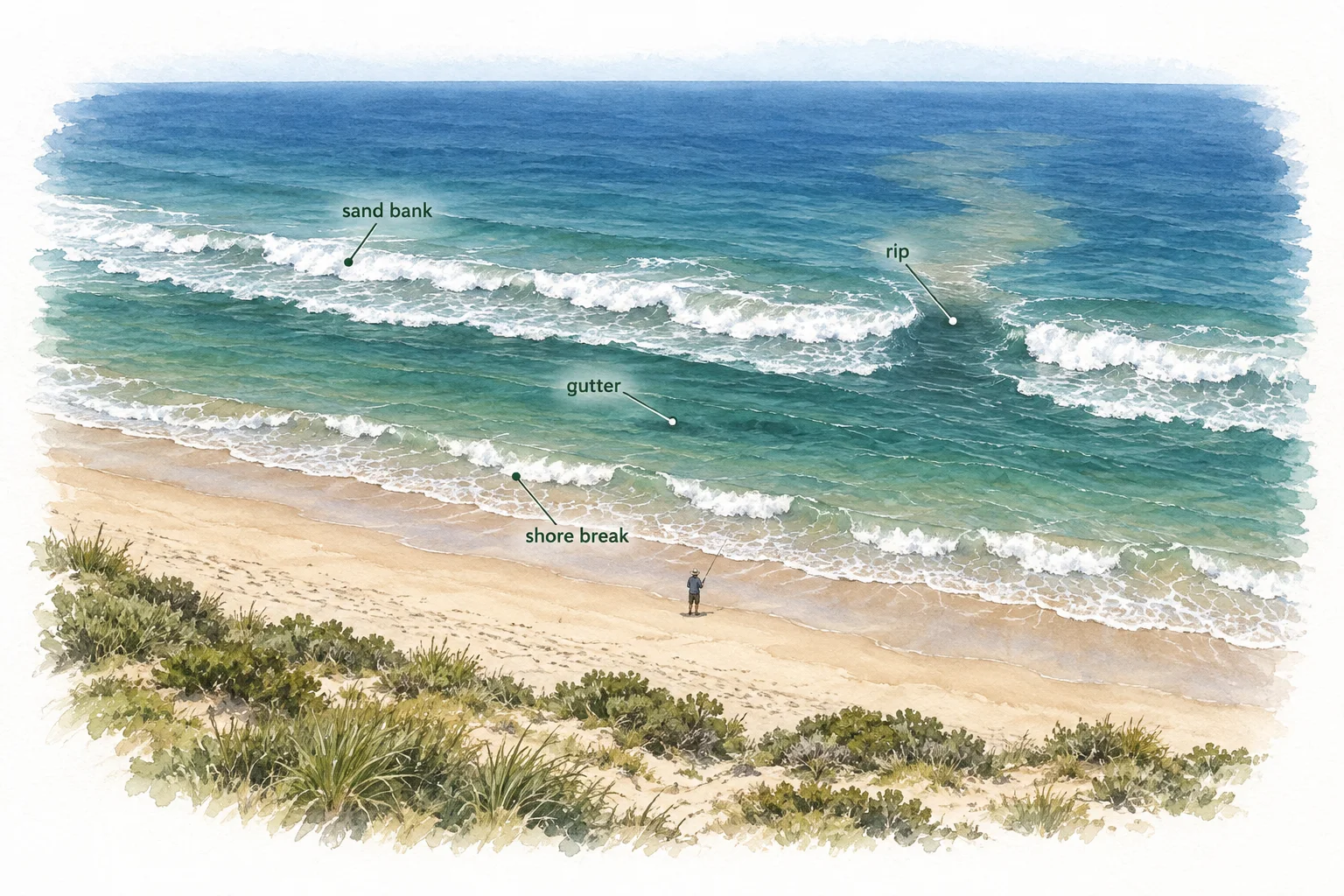
What it means on the water
| Feature | Shows as | Holds | Best time |
|---|---|---|---|
| Gutter | Dark green water, no waves breaking | Bream, whiting, dart on the calm side | Last half of rising tide, dawn or dusk |
| Hole (melon hole) | Dark blue-green patch, waves don't break over it | Mulloway at night; flathead, bream at low tide | High tide at night; low tide by day |
| Entrance / rip | Funnel of clean water flowing fast to sea | Fish moving between gutter and open water | Low tide and on the run-out |
| Outer channel | Second, longer gutter beyond the inner one | Sharks and pelagics: mackerel, tuna, trevally | Low tide and on the run-out |
| Back-bank edge | Edge of the sandbank behind the breakers | Tailor, salmon and dart prowling the edge | Any tide, best at dawn or dusk |
| Shore break | Waves surging and breaking hard on the sand | Herring and whiting foraging in the wash | High tide, waves under 0.5 m |
| Sand spit | Point of sand exposed at low tide | Whiting feeding on the banks as the spit floods | Low tide exposed; whiting at high tide, 0.5-1 m |
| Beach corner | Permanent gutter where sand meets rock | Whiting, most productive in calm conditions | Low tide, one hour either side |
How to use it
Scout from high ground at low tide
Read the beach from a dune, cliff or headland, ideally at low tide around midday, when the overhead sun sharpens colour differences and gutters, holes and banks are at their clearest.
Read the dry sand first
Look at the dry beach above the waterline before looking at the water. A high, steep bank suggests a gutter close in; a flat beach suggests a sand bank out front.
Find the break, then check both sides
Locate a stretch where waves break consistently, then scan either side for rip signs: deeper or darker water, fewer breaking waves, discoloured or sandy-coloured water, debris, a calm patch, or a ripple pattern on the sand. Watch for waves that break late or not at all.
Choose a gutter within casting range
Pick a dark patch of water within casting range, with sand banks on either side and an entrance at one or both ends. If a longshore sweep is running, fish the downcurrent side of that entrance.
Match the tide to the feature
On the rising half, fish a bank sitting between two entrances, where fish feed on worms and pipis. At low tide and on the run-out, fish holes, rips and gutters instead.
Tip Some holes hold fish at every tide stage, from low through to half tide.
Watch first, then cast short and accurate
Watch the water for a few minutes before casting, looking for fish shadows, diving birds or surface shimmer. Then cast a short, accurate line to the edge of the gutter rather than reaching for the far bank.
Tip A cast that lands on the far sand bank misses fish foraging in the shore break.
On fly, rig for the gutter
For Australian salmon in Victorian surf, use an intermediate or sinking line with a stripping basket, casting surf candies, deep candies or Clouser minnows along the gutter as the tide moves. This is forum advice, not from an edited source.
Common misreads and how to fix them
Casting too far lands the bait on the far sand bank, not the gutter.
Instead Cast short, into the dark water close to shore.
Fishing last month's gutter: features shift, and flash rips appear without warning.
Instead Rescout from the dune each trip, at low tide.
A hole shows as smooth whitewater and gets walked past.
Instead Watch for a smooth patch, ocean-coloured, inside the broken water.
Surf too flat, or too big, pushes fish away from the beach.
Instead Fish moderate surf; skip glassy calm and heavy blown-out swell.
A rip's calm-looking surface is mistaken for a safe place to wade.
Instead Stay out: rips pulse above 2 m/s (sources say up to 2.5 m/s) and drown 21+ people yearly in Australia.
Common questions
Is it better to fish the gutter at high tide or low tide?
Low tide and the run-out favour holes, rips and gutters themselves, when fish are concentrated in the deeper channels. On the rising half, target a sand bank sitting between two entrances instead, where fish move up to feed on worms and pipis.
Should I cast into the rip itself or beside it?
Fish the edge of the rip or gutter, where the moving current meets calmer water, rather than the middle of the flow itself. That edge is where feeding activity concentrates, not the fastest-moving water.
How far out should I cast on a surf beach?
A short, accurate cast into a gutter or edge close to shore usually beats a long cast into open water. Casting too far puts the bait on the sand bank on the far side of the gutter, past where fish are foraging.
Which way should I fish when there's a strong sweep running?
Fish the downcurrent side of a rip or gutter entrance when a longshore sweep is running. Current direction along the beach determines which side of the entrance holds feeding fish.
Can I fish a beach at night, and how do I read it without the colour?
Gutters, holes and rips are mapped in daylight at low tide, since that is when the colour and shape of each feature shows clearly. Fish, including mulloway, then move in close and patrol the inner gutters after dark, so the daytime map is fished that night by memory, not by sight.
Why does a gutter that fished well last month hold nothing now?
Rip and gutter features can change shape and location quickly, and the water depth over each one shifts with the tide, so a gutter that produced last month may have filled in or moved. Rescouting from the dune at low tide before each trip picks up the change.
Main sources
- The Fishing School - Gutter Tactics with Pat BrennanFishing World Australia
- Mastering the art of how to read the beachFishing Monthly (Sean Thompson)
- Reading the BeachDuff's Salamander Bay Bait & Tackle
- Beach TypesSurf Life Saving New Zealand (information from NIWA)
All 17 sources
- Rip Current Safety — Science of the Surf · Science of the Surf (Dr Rob Brander, UNSW)
- Rip Current Flow Behaviour — Science of the Surf · Science of the Surf (Dr Rob Brander, UNSW)
- Rips | SLSNZ · Surf Life Saving New Zealand
- 13 Beach types · Earth Sciences New Zealand (NIWA)
- Gutter Tactics - Part II · Fishing World Australia (Pat Brennan)
- Beach whiting tactics part one: location and tackle · BNB Fishing Mag (Sean Thompson)
- Surf Life Saving Australia Coastal Safety Fact Sheets: Beach Safety – Rip Currents · Surf Life Saving Australia
- Surf Fishing the Beach and Targeting Structure · ReproBaits Tackle
- Salmon of the southern surf · Fishing World Australia (Martin Auldist)
- Surfcasting in New Zealand | A Beginner's Guide to Catching Fish From the Beach · Daiwa New Zealand
- Chasing Australian Salmon in the surf Lakes Entrance - FlyLife Magazine forum · FlyLife Magazine (forum)
- Surfcasting Tips for Beginners NZ · NZ Fishing Magazine (Allan Burgess)
- Rips can be easy to spot if you know how. Here's how to stay safe this summer · ABC News (quoting SLSA coastal safety manager Michael Bonnici)
Something wrong on this page? Tell us and it gets fixed.