Brown trout
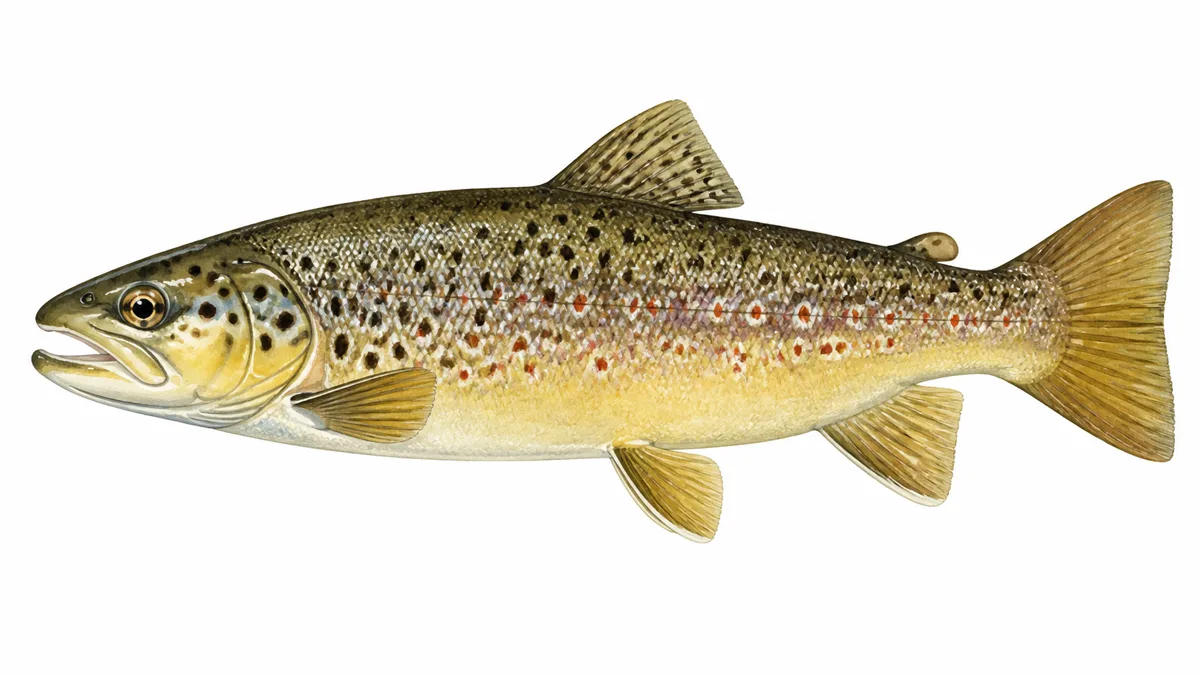
An introduced European salmonid holding in cool, oxygenated rivers, lakes and estuaries, feeding by sight on insects, baitfish and, in tidal reaches, whitebait and smelt. Wary and selective, it favours careful presentation over noise or numbers.
173 guides in the directory fish for brown trout, across 23 regions
- Also called
- sea-run brown trout
sea-run browns, New Zealand brown… - Water
- fresh, estuary
upland rivers and streams, lakes and… - Typical size
- 35-55 cm
1-4 kg - Trophy size
- 90 cm +
10-20 kg
Where guides fish for it
Guides who fish for it
When to fish for it
How it is fished
Sight-fishing nymph and dry fly to cruising browns
Spot a fish holding or cruising in clear South Island and high-country river water, then present an indicator nymph or a natural dry-dropper rig on a drag-free drift; sea-run fish at river mouths take weighted smelt-pattern flies stripped after dark.
When: spring through autumn on rivers; after dark and around the tide at river mouths, November to early March
Casting spinners and spoons
Cast a Tasmanian Devil, Toby or blade spinner across and downstream in rivers, or along lake edges and river mouths, working it back with a steady to erratic retrieve through likely holding water.
When: year-round in rivers and lakes; daytime for spinning, dawn/dusk at river mouths
Jigging soft-plastic minnows and worms
A jig-head-rigged soft-plastic minnow or worm is cast and hopped or slow-rolled along the bottom of pools and lake margins, now a common substitute for hard lures among river and lake anglers.
When: year-round, most productive in lower, clearer water
Harling large flies behind a boat
A large harling fly is trolled slowly behind a drifting or slow-motoring boat with a length of leaded line to get it down through the top few metres, covering the open water of trout lakes.
When: spring through autumn on lakes
Ledgering worm bait
A garden worm is fished on a running ledger rig with split shot pinched onto a dropper, rolled or bounced along the bottom through pools and slack water on a sensitive rod tip.
When: year-round, especially after rain has coloured the water
The outfit
What to actually pick up, per method.
| Method | Rod | Reel | Main line | Leader | Terminal |
|---|---|---|---|---|---|
| Spin | |||||
| Shallow-running lures | 7ft, 7-20 g, light-medium | 2500-4000 size fixed-spool | braid, ~6 lb mono equivalent (about 20 lb braid) | 6-8 lb clear mono or fluorocarbon, about two rod lengths, joined via FG knot | 7-20 g Tasmanian Devils, 10-17 g Tobys, blade spinners, small treble hooks, small snap swivel to prevent line twist |
| Soft plastics | 7ft, up to 10 g, light | 2000-2500 size fixed-spool | 4-6 lb mono or light braid | 4-6 lb fluorocarbon | 1/32-3/8 oz jig heads with 50-75 mm soft-plastic minnows or paddle-tail/worm bodies |
| Bait | 8ft 6in-9ft, soft tip, light, 12-16 g sinker load, soft/sensitive | threadline (fixed-spool) reel, 2500 size | 4-6 lb mono | 4-6 lb mono trace | single size 6 hook on a running ledger rig with split shot, worm bait |
| Overhead | |||||
| Trolling | 8-9ft trolling rod, N/A - trolled, not cast, medium | overhead/levelwind trolling reel | leaded/lead-in line to work the top 5 m, backed with mono | 6-10 lb mono trace | size 2-4 large harling flies |
| Fly | |||||
| Fly | 9ft, 5-6wt, medium-fast | single-action, matched to 5-6wt line with disc drag | weight-forward floating fly line | 9ft tapered leader to 3-6 lb tippet | size 12-16 nymphs and dries; size 2-6 weighted smelt/streamer patterns for sea-run fish after dark |
When they feed, and where
What makes a spot worth stopping at
Features you can pick off the water, and what the fish is doing there.
undercut banks and overhanging streamside vegetation
resident browns hold here through the day for cover and ambush on drifting food, only moving out to feed more openly at low light
approach from downstream and out of sight, drop a nymph or small streamer tight against the bank and let it drift or swing past the lie
riffle-to-pool current seams
fish hold in the sheltered slack beside the main current, nose upstream, picking off nymphs and drift food funnelled off the adjacent riffle
cast up and across into the seam, dead-drift a nymph or unweighted wet through the transition where fast water tips into the pool
river mouth gut and surf zone
shallow water at the river mouth concentrates baitfish and sea-run browns push in to ambush them, often boiling the surface as they feed
spin or swing a weighted smelt fly through the gut, working it back across the current on a pushing or falling tide
estuary channels and current edges
as the tide drops, sea-run fish retreat off the shallow flats into the deeper channels and hold along the current edge to intercept baitfish being drawn out
work a spinner, soft-bait or smelt fly along the edge of the channel, letting it swing with the current rather than retrieving straight back
first rapids above tidal influence
these obstacles slow and disorient upstream-running baitfish, creating a reliable ambush point where sea-run browns stack up
fish the pool immediately below and beside the rapid, drifting bait or swinging a lure through the slower water alongside the fast tongue
weed beds in lowland lakes
weed holds the snails, koura and damselfly/dragonfly nymphs that lake-resident browns cruise the edges hunting for
sight-fish or blind-cast along the weed edge with a nymph or small soft plastic, working it slowly past gaps and channels in the weed
What it eats, and what to tie on
Diet
Brown trout are opportunistic predators whose diet is dominated by aquatic insect larvae, drifting nymphs making up the bulk of daily feeding, but they switch onto terrestrial windfalls and baitfish whenever these become abundant. Lake fish work weed beds for snails, koura and damselfly/dragonfly nymphs, while sea-run fish in Southland and similar fisheries follow whitebait and smelt runs into estuaries.
Prey: mayfly nymphs, caddis larvae, stonefly nymphs, cicadas, beetles, smelt, bullies, whitebait, koura/crayfish, snails, damselfly and dragonfly nymphs, mice
Bait
- live or dead smelt — drifted or slow-trolled around river mouths and estuary channels for sea-run fish
- bullies — drifted near the bottom in river mouth pools and channels
Lures and flies, by type
Length and weight are the point — match them to the cast weight in the outfit table.
| Type | Length | Weight | Depth | Colour | How it is worked |
|---|---|---|---|---|---|
| Hard bodies | |||||
| revolving-blade spinner | 40-60 mm | 7-14 g | sub-surface to about 1 m | silver/black in clear water, gold or fire-tiger in discoloured water | Celta- and Vibrax-style blades and Tasmanian Devil wobblers are standard river and river-mouth spinning lures; yellow-grey patterns favoured at river mouths after dark |
| shallow-diving minnow | 40-70 mm | 3-5 g | 0.3-1 m | brown trout pattern or bait-fish silver | a light setup casting small 3-5 g lures is standard for stream and small-river work |
| trolled/casting minnow | 80-130 mm | 8-15 g | 1-3 m | baitfish silver or brown trout pattern | Rapala floating and countdown divers up to 13 cm are used for casting and trolling larger highland lakes |
| Soft plastics | |||||
| small baitfish paddle-tail | 50-80 mm | 3-7 g jig head | surface to 1.5 m | translucent/natural in clear water, brighter in dirty water | increasingly used in place of flashy hardbodies at river mouths and estuary channels |
| Flies | |||||
| Pheasant Tail / Hare and Copper nymph | 12-20 | unweighted to lightly beaded | — | — | primary imitation of drifting mayfly and caddis nymphs in clear NZ rivers |
| Woolly Bugger | 8-12 | weighted, fished on a sinking or intermediate line | — | — | stripped down and across to imitate baitfish or large invertebrates in rivers and lakes |
| cicada dry | 6-10 | floating line | — | — | essential mid-January to March when cicada falls trigger surface feeding |
| Adams Parachute dry | 12-16 | floating line | — | — | general mayfly-hatch imitation on calmer water |
| weighted smelt streamer | 6-8 (long shank) | weighted, cast on monofilament or intermediate line | — | — | swung through river-mouth guts and estuary channels for sea-run fish, especially after dark |
| mouse pattern | large, 6-8 cm body | floating line | — | — | targets trophy fish, most effective at night during beech mast mouse years |
Rules and limits
| Zone | Legal length | Bag / possession | Closed season | Source |
|---|---|---|---|---|
| New South Wales — inland (freshwater) — general trout streams, trout dams and other waters | 25 cm | 5 (one or more species) / 10 (one or more species) | Tuesday after the June long weekend to the last Friday prior to the start of the October long weekend (general trout streams). For 2026 DPIRD states the closure commences Tuesday 9 June 2026 and waters reopen from the start of the October long weekend, Saturday 3 October 2026. | NSW DPIRD Fisheries (Department of Primary Industries and Regional Development) · read 2026-08-21 Bag and possession limits are combined across trout and salmon species (Atlantic Salmon, Brown, Rainbow, Brook). Different limits apply in artificial fly and lure only waters (25 cm, bag 2, possession 4) and in trout spawning streams from 1 May to the end of the King's Birthday long weekend (50 cm, bag 1, possession 2) — see exceptions. The stream closure does not apply to trout dams. Closure dates for artificial fly and lure streams and trout spawning streams run 'Tuesday after the June long weekend until midnight 30 April the following year'. |
| New Zealand — marine | Not confirmed for this zone — check Fisheries New Zealand (Ministry for Primary Industries) → | absence is not “no limit” | ||
| New Zealand — sports fish | Not confirmed for this zone — check Fish & Game New Zealand → | absence is not “no limit” | ||
| New Zealand — Taupō District — freshwater — Taupō Fishing District (all waters except the exceptions listed) | 35 cm min | 8 / not specified on the authority's pages | Lake Taupō itself has no closed season (licence year 1 July to 30 June); other waters in the district have defined open seasons or are closed at all times — see DOC's map of the Taupō Fishing District | Department of Conservation (Taupō Fishing District) · read 2026-08-21 Bag limit is "eight trout per day regardless of species", so brown and rainbow trout share one combined daily limit. Size is measured "tip of the snout to the fork of the tail". Raised from six to eight effective 1 July 2026. Different limits apply at Lake Otamangakau, Lake Kuratau, Lake Moawhango and the Waipakihi River above the Rangipo Dam — see exceptions. |
| Tasmania — inland — inland — lakes, reservoirs, tarns, ponds, pools, swamps, marshes, dams and waterholes (general default) | 300 mm min | 12 / not stated by the authority for salmonids | open season for most waters: 1/8/2026 - 2/5/2027; closed outside those dates (14 listed waters are open year-round) | Inland Fisheries Service (Tasmania) · read 2026-08-21 Brown trout is a "salmon" (family Salmonidae) under the Inland Fisheries Act 1995, so reg 15(5) (300 mm) and reg 17(2)(b) — "a person must not take, on any one day from inland waters or excepted waters, more than a total of 12 salmon" — apply. The bag limit of 12 is a COMBINED salmonid limit, not per-species. Many individual waters set stricter size/bag limits (see exceptions and the A to Z of Waters). Measured "from the tip of the snout to the fork of the tail". Reg 17(8) sets an explicit possession limit only for eels (24); no equivalent salmonid possession limit was found in the regulations. |
| Tasmania — inland — inland — any river | 220 mm min | 5 (per river, per day) / not stated by the authority for salmonids | open season for most waters: 1/8/2026 - 2/5/2027; stated downstream sections of the Huon River, River Derwent and River Leven are open year-round | Inland Fisheries Service (Tasmania) · read 2026-08-21 Reg 15(3): salmon under 220 mm must not be taken from any river. Reg 17(6): "maximum 5 salmon daily from same river" — a combined salmonid limit. Individual rivers may be stricter (e.g. IFS river brochures show 220 mm / bag 5 for the South Esk and Macquarie, and 220 mm / bag 12 for the Tyenna). |
| Tasmania — inland — inland — Huntsman Lake, Lake Burbury, Lake Gordon, Lake King William, Lake Pedder | 220 mm min | 12 / not stated by the authority for salmonids | Lake Pedder is one of the 14 year-round waters; the others follow the 1/8/2026 - 2/5/2027 season unless listed otherwise | Inland Fisheries Service (Tasmania) · read 2026-08-21 Reg 15(3) gives these named lakes the 220 mm river-style minimum rather than the 300 mm still-water default. Bag limit is the general 12 combined salmonids unless the water appears in Schedule 3. |
| Tasmania — marine — marine (seaward of the seaward limit) | no minimum size in marine waters | 12 / 24 | none stated for marine waters; upstream of a seaward limit and in bream fishing areas the Inland Fisheries Service seasons apply and a freshwater angling licence is required for trout | NRE Tas (Department of Natural Resources and Environment Tasmania) — Wild Fisheries Management Branch, Recreational Fisheries Section · read 2026-08-21 NRE Tas lists the row generically as "Trout (in marine waters)" — it is not split by trout species, so this limit is the one that applies to sea-run brown trout taken in marine waters. No boat limit listed. Inland (IFS) bag and size limits differ and "can change from water to water". |
| Victoria — inland (fresh) - rivers, streams, lakes and impoundments | No minimum in most waters; 45 cm minimum at Lake Toolondo and Hepburn Lagoon; 25 cm minimum in the listed upper-river sections | 5 salmonids per day (combined across all salmonid species); in rivers and streams no more than 2 fish may exceed 35 cm; 3 salmonids per day in the listed exception waters / not specified by the authority (no separate possession limit applies to salmonids) | Rivers and streams: 'from Tuesday 9 June until Friday 4 September inclusive' (2026); first open day Saturday 5 September 2026. No closed season in lakes and impoundments, in the Merri, Hopkins and Moyne rivers and Mt Emu Creek, or in specified sea-run trout river sections. | Victorian Fisheries Authority (VFA) · read 2026-08-21 Size and bag limits 'vary with water body and/or river section'; the bag limit is a combined salmonid limit. Cannot be filleted in or on Victorian waters - must be kept whole or in carcass form until away from the water. |
Blowering Dam and Copeton Dam: Exempt from the annual Murray Cod closure — Murray Cod may be taken all year in these two dams, while all other waters are closed 1 September to 30 November. · Trout spawning streams — Thredbo River and Eucumbene River (and tributaries): From 1 May to the end of the King's Birthday long weekend these waters run under separate spawning-stream rules: 50 cm minimum size, daily bag limit 1, possession limit 2, artificial fly or lure only (no handlines, no dough-based baits). · Artificial fly and lure only waters (incl. blue ribbon streams, catch-and-release streams, trophy trout dams, trout spawning streams): Notified trout waters split into two classes; in artificial fly and lure only waters the trout daily bag limit is 2 and possession limit 4 (instead of 5 and 10), and bait is prohibited. The Eucumbene and Thredbo Rivers sit in this class from the Saturday of the October long weekend to 30 April inclusive.
In the kitchen
Pan-fried
Classic treatment - butter, almonds and lemon suit the fine flesh well.
Baked whole
Stuffed and baked in foil, a traditional way to serve a whole fish.
Smoked
Manuka-smoked trout is a well-known NZ preparation, cured first for flavour.
Poached
Gentle method suited to the fine, soft texture of the flesh.
Watch


Common questions
What is the best time of year to catch brown trout?
Spring through autumn, once rivers open after the winter spawning closure. In New Zealand most brown trout rivers open on 1 October and fish are in prime condition through summer into April, while in Tasmania the season typically runs August to May with September–October and the October–March mayfly-hatch stretch producing the best sport. Exact opening and closing dates vary by region and water, so check the local rules before you go.
How big do brown trout get?
Most brown trout landed by anglers weigh 1–2kg, but resident river fish can reach 800mm and 5kg. Sea-run browns that feed on mullet, sprats and smelt in estuaries grow much larger again, with fish up to 7kg or more recorded and anything over 5kg considered a trophy.
How do you tell a brown trout apart from a rainbow trout?
Look at the tail: rainbow trout carry dark spots on the caudal (tail) fin, while brown trout almost never do. Browns also show red spots alongside their black spotting, especially in river fish, and have noticeably larger pectoral fins than rainbows. Colour is a less reliable guide, since it shifts with habitat: river browns run golden-brown while lake fish are duller and more silver.
Do you need a licence to fish for brown trout?
Yes. In New Zealand every angler, including children, needs a Fish & Game licence to fish for trout anywhere outside the separately-managed Taupō district. In Australia a freshwater fishing licence is likewise required in most states. Bag limits, size limits and licence costs all differ by region, so check the rules for the specific water before you fish.
Are brown trout good to eat?
Yes, though flavour depends heavily on size and diet. Smaller fish in the 1–2kg range have firmer flesh and a milder taste than large, old trout, and fish that have been feeding on crabs and other crustaceans in estuaries or river mouths tend to have deep-red, well-flavoured flesh. As with any wild-caught fish, only keep trout from clean water you trust.
Are brown trout hard to catch?
Brown trout have a reputation as the wariest of the trout species, quick to spook in bright, clear, low water and sensitive to noise and shadow on the bank. A quiet approach, a drab profile and an accurate first cast matter more than fancy gear, and a basic 6-weight fly outfit with a floating line is enough to get started on most AU/NZ trout water.
Fishing for brown trout on water you don't know?
A guide who fishes it every week writes you a plan for your water and your dates.