Murray cod
Murray cod is Australia's largest freshwater fish, an ambush predator that holds tight to snags, rock bars and timber in slow-flowing rivers and impoundments. Baits and lures need to be worked hard against that cover, not just cast near it.
33 guides in the directory fish for murray cod, across 16 regions
- Also called
- Goodoo
Ponde, Greenfish - Water
- fresh
rivers, creeks and stocked… - Typical size
- 60-100 cm
3-20 kg - Trophy size
- 1.2 m +
40 kg +
Where guides fish for it
Guides who fish for it
When to fish for it
How it is fished
Topwater lures over snags at dawn and dusk
Cast large wooden or hard-bodied surface lures tight to snags, weed edges and rock bars and work them with a walk-the-dog or slow chugging retrieve; strikes are often explosive and visible.
When: dawn and dusk through summer, especially stable warm periods in January-February
Casting spinnerbaits at snags and points
Cast past timber, rock bars or points and let the spinnerbait sink on a tight line so the blades spin down through the strike zone, then wind it back slowly and deep, hopping it over structure when it makes contact.
When: year-round, especially in coloured or discoloured water
Trolling deep-diving hardbodies
Troll one or two large deep-diving hardbodies (or big spinnerbaits) along snags and channel edges in 4-10 m of water so the lure bibs grind into timber and the bottom, using a sounder to locate structure.
When: year-round, particularly useful for covering water and locating fish in unfamiliar impoundments
Soaking bardi grubs or yabbies in snags
Anchor or tie up near a snag or deep hole, present a bardi grub, scrubworm, shrimp or yabby on a running sinker rig hard against the structure, and wait for the fish to find it.
When: year-round, a mainstay technique for over a century
Sight- and blind-casting large flies
Cast large baitfish or deer-hair pattern flies to snags and structure on a heavy fly outfit, using an intermediate or sinking line to get flies down to holding cod in deeper water.
When: warmer months when cod are active in the shallows and along structure
The outfit
What to actually pick up, per method.
| Method | Rod | Reel | Main line | Leader | Terminal |
|---|---|---|---|---|---|
| Baitcast | |||||
| Surface lures | 6ft 4in to 6ft 6in, 14-56 g, fast, medium-heavy to heavy | low-profile baitcaster, 6.3:1 or faster | 15-30 lb braid | 16-20 lb mono, 1 rod length | large single or twin-treble wooden/hard-bodied surface lures |
| Spinnerbaits | 6ft to 6ft 6in, 14-56 g, medium-heavy to heavy | low-profile baitcaster, high torque | 30-50 lb braid | 30-60 lb fluorocarbon, 1 to 1.5 rod lengths | large wire-form spinnerbait, single or tandem willow blades, heavy-gauge 3/0-5/0 hook, optional stinger/trailer hook |
| Deep divers | about 6ft, 30-90 g, heavy, sturdy trolling blank | baitcaster or overhead with line-out alarm | 50 lb braid | 60 lb mono or fluorocarbon, about 1.5 m | large deep-diving hard-bodied lures rated to 8 m+, or plus-sized trolling spinnerbaits |
| Spin | |||||
| Bait | 7ft, medium-heavy, matched to running sinker rig, medium-heavy | 4000-6000 size spin reel | 50 lb braid | 60 lb mono or fluorocarbon, about 1.5 m | running sinker rig, swivel, 4/0-7/0 circle or octopus/suicide hook |
| Fly | |||||
| Fly | 9 ft, 9-10 weight line, fast, heavy-power | large-arbor fly reel with strong drag | 9-10 weight floating or intermediate/sinking fly line | 15-60 lb fluorocarbon depending on structure, 4-6 ft | large baitfish or deer-hair streamer patterns, size 2/0-4/0 |
When they feed, and where
What makes a spot worth stopping at
Features you can pick off the water, and what the fish is doing there.
submerged timber and snags
Fallen trees and stumps give cod overhead cover and a current break to ambush baitfish from
Cast tight past the timber and work the lure or bait right along the edge of the structure rather than over open water
rock bars and granite boulders
Boulders create current seams and shaded pockets that hold both baitfish and resting cod
Work spinnerbaits or vibes slowly through the gaps between rocks, keeping contact with the bottom
deep holes and river gorge pockets
These act as thermal refuges in summer heat and cod stack up in them during the day before moving shallower to feed at night
Troll deep-diving hardbodies through the hole at trolling speed, or vertically work a vibe on the bottom
undercut clay banks and overhanging vegetation
Undercuts and overhead cover give cod shade and an ambush point close to the bank
Cast surface lures or shallow hardbodies tight against the bank and work them past the undercut
long shallow banks at first and last light
Cod move onto shallow flats to hunt baitfish in the low light of dawn and dusk
Walk a surface lure or swimbait steadily across the flat, pausing over any subtle depth change
What it eats, and what to tie on
Diet
Murray cod are apex ambush predators that eat almost anything smaller than themselves, and hunt mainly by lying up against structure and inhaling prey that strays into range rather than chasing in open water. Fish make up the bulk of the diet of mature cod, supplemented heavily by yabbies and freshwater shrimp.
Prey: golden perch, silver perch, bony bream, carp, redfin, yabbies, freshwater shrimp, Murray crayfish, frogs
Bait
- live yabby — hooked through the tail on a 5/0-6/0 recurve or circle hook for safe release
- raw chicken — a cheap, durable standby fished on the bottom near structure
- bardi grub — fished whole on a light-gauge hook near timber
- cheese — an old-school bait still used bottom-fished around snags
Lures and flies, by type
Length and weight are the point — match them to the cast weight in the outfit table.
| Type | Length | Weight | Depth | Colour | How it is worked |
|---|---|---|---|---|---|
| Surface | |||||
| walker/swimbait surface lure | 100-180 mm | — | — | dark silhouette colours for pre-dawn, brighter colours once light comes up | worked over long shallow banks and flats at dawn and dusk |
| Hard bodies | |||||
| shallow-diving minnow | 70-100 mm | — | 1-2 m | bait-pattern in clear water, brighter chartreuse or orange in dirty water | the all-round size for both casting and trolling, accounts for numbers of fish of all sizes |
| deep-diving trolling minnow | 100-160 mm | — | 4-9 m (to around 9 m on some models) | black bib patterns for low light, natural bait colours in clear water | used to reach cod holding deep in summer heat; two lures typically trolled at once |
| Vibes and blades | |||||
| soft or hard-bodied vibe | 70-100 mm | 14-28 g | bottom of the water column | natural bait colours | hopped along the bottom around rock bars and drop-offs |
| Spinnerbaits | |||||
| Colorado-blade spinnerbait | — | 18-28 g (5/8-1 oz) | 0.5-3 m depending on retrieve | purple/black with silver blades at night, green/yellow/orange in daylight | retrieved slowly to give the blade a slow rotation past structure |
| Flies | |||||
| articulated baitfish streamer | 150-180 mm | sink-tip or full-sink line | — | — | built to push water and get down quickly around deep snags, worked with strong strips to dart the fly |
| cod popper/frog popper | 100-150 mm | floating line | — | — | worked over shallow banks at dawn and dusk to draw violent surface eats |
Rules and limits
| Zone | Legal length | Bag / possession | Closed season | Source |
|---|---|---|---|---|
| New South Wales — inland (freshwater) | 55 cm to 75 cm | 2 / 4 | 1 September to 30 November, except Blowering and Copeton Dams | NSW DPIRD Fisheries (Department of Primary Industries and Regional Development) · read 2026-08-21 Slot limit — fish under 55 cm and over 75 cm must be released. Open season stated on the limits table as 'December to August; all year in Copeton and Blowering Dams'. DPIRD publishes separate guidance on photographing large Murray Cod. |
| Queensland — fresh | Min: 60cm | n/a — Queensland sets possession limits, not daily bag limits / Limit: 2 | from 1 August to 31 October | Queensland Department of Primary Industries (Fisheries) / Queensland Government · read 2026-08-21 Applies in the Queensland part of the Murray-Darling Drainage Division. Authority page notes 'Closed season applies'; dates quoted from Fisheries Declaration 2019 s 33. Mary River cod is a separate species with its own, largely no-take, rules — do not conflate. |
| South Australia — inland — South Australian section of the River Murray proper, and Lakes Alexandrina and Albert | no take permitted — catch and release only | 0 / 0 | 1 August to 31 December (targeting prohibited) | PIRSA (Primary Industries and Regions South Australia) — Fisheries and Aquaculture · read 2026-08-21 From 1 January to 31 July recreational fishers may catch and release Murray Cod only — there is a zero take limit, so no fish may be kept at any time of year. Targeting or taking during the closed season carries a penalty of up to $20,000. Fishers must use appropriate gear and handle fish with extreme care, including on unintentional capture. Catch and release of Murray Cod is permitted year round when reservoir fishing. |
| Victoria — inland (fresh) | 55 cm minimum, 75 cm maximum | 1 in rivers; 2 in specified lakes and impoundments; 2 in urban lakes / 5 fish, or less than 30 kg in any other form, anywhere in Victoria | 1 September to 30 November (inclusive), except in the waters listed under exceptions | Victorian Fisheries Authority (VFA) · read 2026-08-21 Slot limit - fish outside 55-75 cm must be released. Must be kept whole or in carcass form while in or on Victorian waters (filleting permitted once away from the water or at boat ramp cleaning tables). |
Blowering Dam and Copeton Dam: Exempt from the annual Murray Cod closure — Murray Cod may be taken all year in these two dams, while all other waters are closed 1 September to 30 November. · Trout spawning streams — Thredbo River and Eucumbene River (and tributaries): From 1 May to the end of the King's Birthday long weekend these waters run under separate spawning-stream rules: 50 cm minimum size, daily bag limit 1, possession limit 2, artificial fly or lure only (no handlines, no dough-based baits). · Artificial fly and lure only waters (incl. blue ribbon streams, catch-and-release streams, trophy trout dams, trout spawning streams): Notified trout waters split into two classes; in artificial fly and lure only waters the trout daily bag limit is 2 and possession limit 4 (instead of 5 and 10), and bait is prohibited. The Eucumbene and Thredbo Rivers sit in this class from the Saturday of the October long weekend to 30 April inclusive.
In the kitchen
Baked whole
Firm flesh and thick frame suit a whole roast intact.
Pan-fried
Skin crisps well and the flesh stays firm, not flaky-soft.
Smoked
Low oil content takes smoke flavour without turning dry.
Deep-fried
Firm tail-end pieces hold shape in hot oil.
Watch


Common questions
When is the best time of year to catch Murray cod?
Autumn and winter are widely regarded as the most productive periods, with cod becoming more active as water temperatures shift after the summer heat. The main open season runs from 1 December to 31 August each year, since a spring closure protects fish through their breeding period. Only Copeton Dam in NSW stays open to Murray cod fishing during that closed season.
How big do Murray cod grow?
In larger rivers and impoundments, Murray cod typically reach 90 to 100cm and 15 to 20kg, while fish in smaller streams usually top out around 60cm and 3 to 4kg. Specimens of 120 to 130cm and 35 to 45kg are occasionally reported. The largest ever documented was a 183cm, 113kg fish reportedly taken from the Barwon River in 1902, though that historic claim is treated with some caution by researchers.
Can you eat Murray cod?
Yes, Murray cod has firm, pearly white flesh and is a popular table fish, but size and bag limits apply and differ by state, and released fish outside the legal slot should always go back. The wild population has recovered significantly after a long decline, moving from Critically Endangered to a healthier conservation status, though authorities recently raised minimum legal lengths in NSW, Victoria and the ACT out of concern that too many fish were being taken before reaching maturity. Farmed Murray cod is also widely available and is not reliant on wild-caught juveniles.
Do I need a fishing licence to target Murray cod?
Yes, anyone 18 or over fishing in NSW fresh or salt waters needs a recreational fishing licence, and the equivalent licensing rules apply across the other states and territories where Murray cod are found. Rules can also depend on exactly which bank or waterway you're fishing from along border rivers like the Murray, so it pays to check which state's licence and regulations apply before you cast a line. Limits and closed seasons apply and differ by state.
How can I tell a Murray cod apart from a trout cod?
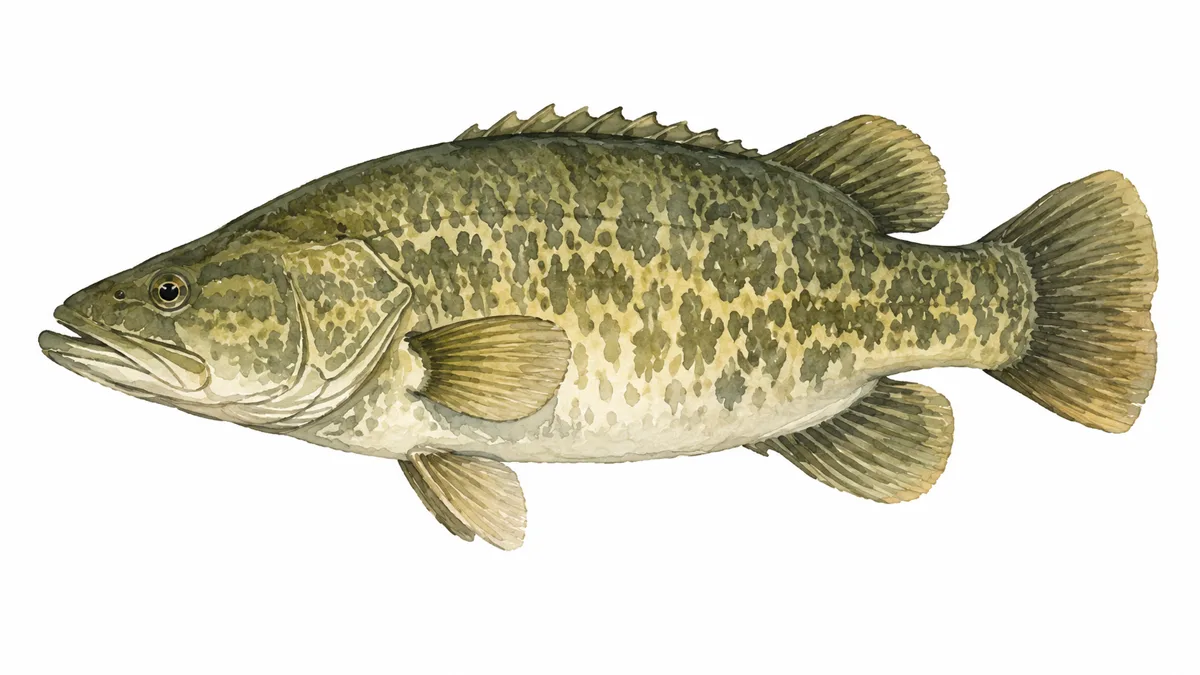
The most reliable difference is the jawline: on a trout cod the upper jaw overhangs the lower jaw when the mouth is closed, while a Murray cod's jaws are roughly even. Murray cod tend to have a concave head profile with a blunt, broad snout and green-olive colouring with a white belly, whereas trout cod have a straighter, more pointed snout, larger eyes and a more blue-grey tone. Colour alone isn't a safe guide since some trout cod show a distinctly greenish colour too, so check the jaw and head shape together.
Fishing for murray cod on water you don't know?
A guide who fishes it every week writes you a plan for your water and your dates.