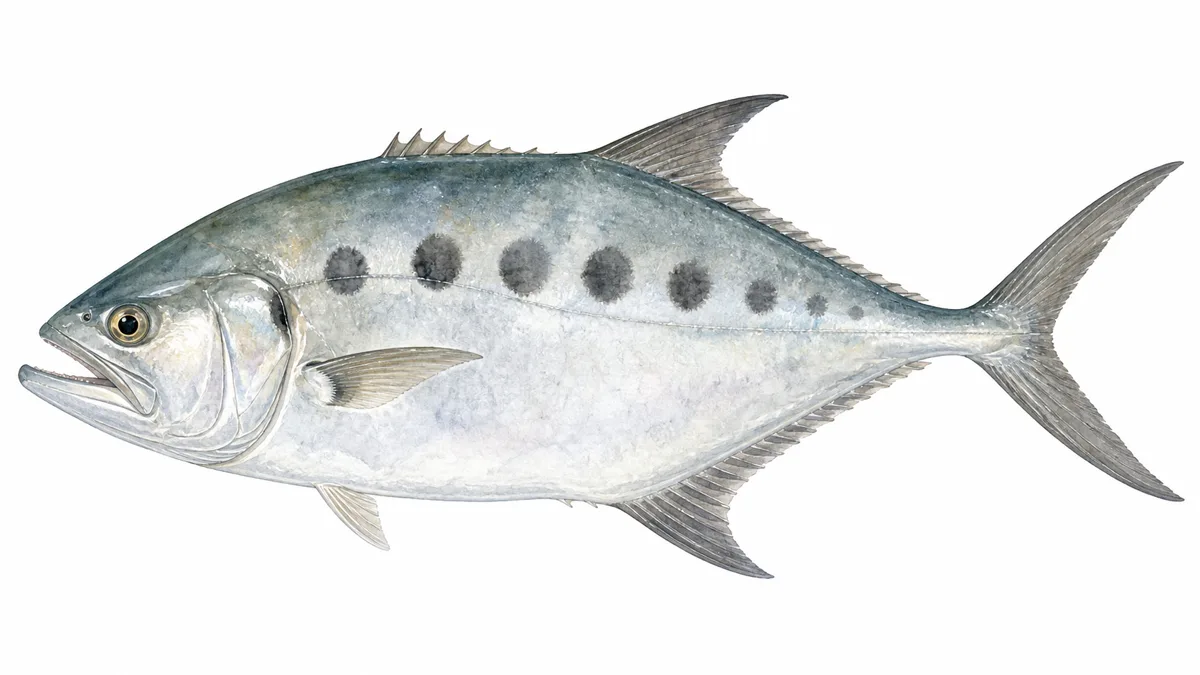
Queenfish
A large silver trevally-relative that patrols tropical flats, estuaries and current lines chasing baitfish. Fish moving tide and dawn/dusk light, on the surface, with poppers or stickbaits worked fast.
60 guides in the directory fish for queenfish, across 14 regions
- Also called
- Talang queenfish
Queenie, Giant leatherskin - Water
- salt
coastal reefs, sand flats, estuaries… - Typical size
- 50-80 cm
3-7 kg - Trophy size
- 1 m +
14-15 kg +
Where guides fish for it
Guides who fish for it
When to fish for it
How it is fished
Poppers and stickbaits worked fast
Cast poppers and stickbaits at schools busting up on the surface around river mouths, current lines and bait schools, working the lure with an erratic, mostly fast retrieve — sharp pops and short pauses trigger the explosive strikes queenfish are known for.
When: turn of the tide, around river mouths and current edges when fish are visibly working bait on top
Stickbaits and minnows through bait schools
Shallow-diving stickbaits and minnows (Bomber Long A, Sebile Stick Shadd-style lures, Gillies Pilchard/Baitfish Pro) cast and retrieved at mid-water speed through bait schools and along current edges — queenfish lose interest fast, so keep the retrieve brisk and erratic.
When: any tide, worked along current edges and reef/structure margins
Paddle-tails cast into tidal creeks
White paddle-tail minnows and jerk shads jigged on light heads and worked through bait schools and current lines in tidal creeks and along tropical flats; hard vibes are swapped in when fishing deeper water.
When: low tide, as fish move out of mangrove-lined creeks; peaks through the wet season
Live or fresh garfish drifted in current
Live or fresh-dead garfish, small mullet or scad fished on a running rig and drifted through moving water at river mouths, where queenfish sit to ambush baitfish pushed out on the current. Wire traces are skipped — queenfish are leader-shy and a wire trace reduces bites — unless larger toothy species like Spanish mackerel are also about.
When: run-out tide at river and creek mouths, wherever current is pushing hard
Clousers and poppers stripped fast to cruising fish
Sight-cast to cruising or surface-schooling queenfish with Clouser minnows, Deceivers, baitfish patterns or popper/crease flies, then strip as fast as the angler physically can — queenfish very rarely refuse a fly moved too quickly, and popper flies draw especially explosive eats.
When: sight-fishing flats and visible surface schools, any tide with good light
The outfit
What to actually pick up, per method.
| Method | Rod | Reel | Main line | Leader | Terminal |
|---|---|---|---|---|---|
| Spin | |||||
| Surface lures | 1.8m to 2.4m, 20-40 g, medium | 3000-4000 size, high-speed | 30-50 lb braid | 30-40 lb fluorocarbon | poppers/stickbaits around 90 mm (3 in), trebles, barbs crushed for release |
| Shallow-running lures | 1.8m to 2.1m, 10-30 g, medium | 3000-4000 size | 20-30 lb braid | 20-30 lb fluorocarbon | shallow-diving stickbaits/minnows 85-120 mm, trebles |
| Soft plastics | 1.8m to 2.1m, 7-14 g, medium | 2500-3000 size | 20-30 lb braid | 20-30 lb fluorocarbon | 4.2-5 in paddle-tail minnows/jerk shads on 1/4-3/8 oz jig heads, 2/0-4/0 hooks |
| Bait | 1.8m to 2.4m, 20-40 g, medium | 3000-4000 size | 6-8 kg mono or equivalent 20-30 lb braid | 20-30 lb fluorocarbon, no wire unless mackerel present | running sinker rig, single hooks to 7/0, whole garfish/mullet/scad |
| Fly | |||||
| Fly | 9 ft, 8-10 wt, fast | large-arbor saltwater fly reel with sealed drag | floating fly line, 8-10 wt | 15-20 lb tapered fluorocarbon, 9-10 ft | Clouser minnows, Deceivers, popper/crease flies, 2/0-4/0, barbless preferred |
When they feed, and where
What makes a spot worth stopping at
Features you can pick off the water, and what the fish is doing there.
tidal creek and river mouths
Baitfish get swept out (or pushed in) by the current and queenfish station themselves right at the mouth to ambush them, especially on the run-in.
Cast into and across the current seam at the mouth and work lures back with the flow past the drop, rather than dead against it.
shallow sand and coral flats
Big singles and small packs cruise flats hunting schools of mullet and hardyheads in clear, skinny water — the classic sight-fishing scenario for the species.
Spot cruising or feeding fish first, then lead them with a popper, crease fly or baitfish pattern and strip/retrieve fast and erratically as soon as it lands.
mangrove creek edges
Bigger, solitary queenfish patrol the mangrove line hunting mullet holding tight to the structure.
Cast tight against the mangrove edge and retrieve straight out into open water at speed.
reef edges, drop-offs and bommies
Bait schools stack up on the current break where the bottom falls away, and queenfish sit on the edge to pick off strays.
Drift across the edge casting soft plastics or metal slugs down-current and work them back with a fast, erratic retrieve through the upper water column.
rock platforms and headlands
Current wraps around the point and pushes bait past the rocks, giving queenfish a natural ambush lane.
Cast poppers or stickbaits along the current line running off the point and work them back fast.
What it eats, and what to tie on
Diet
Queenfish are fast, aggressive schooling predators that hunt baitfish in the upper half of the water column, often smashing prey on the surface and leaping clear of the water when chasing a school. Adults feed mainly on small fish, with cephalopods and small invertebrates also taken, while juveniles will pick scales and skin tissue off other fish.
Prey: mullet, garfish, scad, sardines, anchovies, prawns, squid
Bait
- live mullet — the livelier the bait the better the response
- live garfish — a favoured natural prey item on northern flats
- prawns — useful when the fish are less lure-responsive
- fresh cut fish flesh or pilchards — fished near reef structure and drop-offs
Lures and flies, by type
Length and weight are the point — match them to the cast weight in the outfit table.
| Type | Length | Weight | Depth | Colour | How it is worked |
|---|---|---|---|---|---|
| Surface | |||||
| popper | 80-120 mm | — | — | white or bait-imitation patterns | primary technique and a good way to locate a school; smaller poppers of 120 mm or less worked in the surface film draw more committed strikes than oversized ones |
| stickbait | 90-130 mm | — | — | silver/white baitfish tones | walk-the-dog action imitating a fleeing baitfish, worked fast |
| Hard bodies | |||||
| shallow-diving minnow | 80-120 mm | 15-25 g | 0.5-1.5 m | bait-pattern in clear water, brighter/gold in dirty water | trolled or cast along current edges and bait schools; a secondary rather than first-choice method |
| Soft plastics | |||||
| paddle-tail baitfish profile | 80-120 mm | 7-14 g jighead | worked through the upper-to-mid column | pilchard or white/silver bait pattern | fast, erratic retrieve — pausing loses their interest |
| Jigs | |||||
| leadhead jig with feather/bulk trimming | 60-90 mm | 7-14 g | bounced near the bottom or worked mid-column | white or bait-pattern feather dressing | small jigs with bulky feather trimmings outfish plain leadheads |
| Metals | |||||
| metal slug | 60-90 mm | 10-40 g | worked through the upper water column | chrome/silver | cast and retrieved fast for casting distance and speed; also worked vertically along reef edges |
| Flies | |||||
| Clouser minnow | 4-6 in, #8 weight minimum | intermediate or floating line | — | — | plain white pattern effective on smaller fish |
| Fat Boy (4/0) | 4-6 in | floating line, #9-10 weight rod for bigger fish | — | — | strong mullet/hardyhead imitation for larger, meter-plus flats fish |
| Deceiver / baitfish streamer | 4-6 in | floating or intermediate line | — | — | general baitfish imitation, stripped as fast as possible |
| popper / crease fly | 3-5 in | floating line | — | — | surface pattern described as very effective on feeding fish |
Rules and limits
| Zone | Legal length | Bag / possession | Closed season | Source |
|---|---|---|---|---|
| Northern Territory | Not confirmed for this zone — check NT Fisheries (Northern Territory Department of Agriculture and Fisheries) → | absence is not “no limit” | ||
| Queensland — tidal | Min: 50cm | n/a — Queensland sets possession limits, not daily bag limits / Limit: 5 | Queensland Department of Primary Industries (Fisheries) / Queensland Government · read 2026-08-21 Listed by the authority as 'Giant queenfish', which is Scomberoides commersonnianus. It appears within the trevally group of the tidal table but carries its own limit of 5 rather than the generic combined trevally limit of 20. | |
| Western Australia — marine and estuarine - northern WA | — | 8 / General finfish possession limit applies | — | DPIRD Fisheries (WA Department of Primary Industries and Regional Development) · read 2026-08-21 Nearshore/estuarine finfish category (mixed-species daily bag limit 16). The 8-fish limit is printed against a grouped row covering trevally and queenfish species not separately named in the tables. No minimum size is printed for queenfish. |
Tidal vs fresh waters: Queensland publishes two separate limit tables — tidal waters and fresh waters — and a species can carry different rules (or appear in only one) depending on which it is taken from; unlisted species fall to a general possession limit of 20 in whichever table applies. · Gulf of Carpentaria vs Queensland east coast: Several species are split into separate east coast and Gulf of Carpentaria entries with different possession limits, sizes and closure dates (Spanish mackerel, black jewfish, barramundi closures). · Northern vs southern Spanish mackerel waters: The Fisheries Declaration 2019 splits the east coast into northern and southern Spanish mackerel waters with entirely different closure regimes — the south has fixed annual February and March closures, the north has moon-phase-based dated closures set year by year out to 2029.
In the kitchen
Raw
bled and iced fresh, makes good sashimi or lime-cured ceviche
Smoked
oily flesh takes smoking well, a favoured northern treatment
Curried
firm flesh holds up in spiced curries and coconut broths
Pan-fried
marinate first, the flesh dries out quickly otherwise
Watch


Common questions
What is the best time of year to catch queenfish?
Queenfish fishing is generally best through the warmer months when they push into estuaries, harbours and inshore reef edges to feed on baitfish schools. Cooler months tend to see fewer fish inshore as they move to deeper or more northern water. Local bait activity is a better day-to-day indicator than the calendar, so watch for surface-feeding baitfish schools.
How big do queenfish get?
Giant queenfish (Scomberoides commersonnianus), the largest of the queenfish species found in Australian and New Zealand waters, can reach up to 120 centimetres in length, though most fish caught by anglers are considerably smaller. Other queenfish species such as the lesser queenfish and barred queenfish are typically smaller-bodied. Size varies noticeably between species, so correct identification matters for gauging what you've caught.
Where do queenfish live?
Queenfish are a pelagic species found around reefs, estuaries and inshore harbours in tropical and subtropical waters, typically in depths from the shallows down to around 100 metres. In Australia the giant queenfish ranges across the north, from Western Australia through the Northern Territory and Queensland. They often push right up into estuaries and river mouths to hunt baitfish, making them accessible from the shore as well as by boat.
Is queenfish good to eat?
Queenfish are edible but rate as only moderate table fish rather than premium eating, with firm, fairly dry flesh that many anglers find unremarkable when simply grilled or fried plain. Bleeding the fish immediately after capture and icing it straight away noticeably improves the result. It's better suited to dishes that work with its firm texture, such as curries, smoking, or a lime-based ceviche, than to a plain fillet.
Do I need a fishing licence to catch queenfish?
Recreational fishing rules, including whether a licence is required and any size or bag limits, are set state by state in Australia and differ again in New Zealand, so check the current rules for the specific state or region you're fishing before heading out. Limits and closures on queenfish also vary by jurisdiction and change from time to time. Always confirm the current regulations with the relevant fisheries department for your location.
Are queenfish hard to catch and fight?
Yes, queenfish are considered one of the hardest-fighting inshore species on light tackle, known for spectacular aerial jumps, twisting and turning as they try to throw the hook. They readily attack surface lures like poppers and are a favourite target for light spin and fly anglers. Because they fight so hard, queenfish can become exhausted quickly, so careful, quick handling improves their chances of survival if released.
Fishing for queenfish on water you don't know?
A guide who fishes it every week writes you a plan for your water and your dates.