Rainbow trout
A stream and lake salmonid introduced from North America, now self-sustaining in cool alpine and central-plateau waters and stocked elsewhere. It fights harder and rises more freely to a dry fly than brown trout, so match tactics to whether the water is wild or put-and-take.
134 guides in the directory fish for rainbow trout, across 26 regions
- Also called
- rainbow
- Water
- fresh
cool upland rivers, alpine streams,… - Typical size
- 50-60 cm
1-4 kg - Trophy size
- 70 cm +
5-10 kg
Where guides fish for it
Guides who fish for it
When to fish for it
How it is fished
Spinning small lures across rivers and lake edges
Small inline spinners, spoons and shallow hardbody minnows are cast across the current or along lake margins and retrieved just fractionally faster than the flow; casting upstream lets the lure sink before a slow, bottom-brushing retrieve.
When: daytime, best at dawn, dusk and after dark, or when the water is discoloured
Jigging soft plastics through deep pools
Small soft-plastic nymphs or darts on a light jig head are worked slowly through deeper pools and drop-offs, with the rod tip lifted every few seconds to spin the blade or kick the tail.
When: deeper, slower pools and lake basins
Lead-core trolling in lakes and reservoirs
Winged wobblers such as Tasmanian Devils, or small minnow hardbodies, are trolled 30-50 m behind the boat at 2-3 knots; lead-core line or a downrigger gets the lure down to where fish are holding on the thermocline.
When: open-water lake fishing, deeper as the water warms through the season
Bait on the bottom or under a bubble float
Scrubworms, mudeyes, maggots or a dough bait are fished on a light running rig on the bottom, or suspended under a bubble/quill float and allowed to drift naturally.
When: dawn and dusk, stocked lakes and slower river pools
Nymphing under an indicator, with dries and streamers
A beaded nymph on a dropper below a tailing nymph is fished under an indicator through runs and pools; dry flies are matched to the hatch on calm days, and streamers are stripped through deeper water for aggressive or low-light fish.
When: nymphing works year-round; dries suit calm, stable conditions; streamers come into their own at dusk and after dark for bigger fish
The outfit
What to actually pick up, per method.
| Method | Rod | Reel | Main line | Leader | Terminal |
|---|---|---|---|---|---|
| Spin | |||||
| Shallow-running lures | 6ft to 7ft 6in (5ft 6in-6ft for tight streams), 2-15 g, medium-light to medium | 2500-4000 size fixed-spool | 4-6 kg (8-12 lb) braid | 4-6 kg (8-12 lb) fluorocarbon or mono, about two rod-lengths | 3-5 cm hardbodies, spoons and inline spinners, single hooks or small trebles, Fastach clip to reduce line twist |
| Soft plastics | 5ft 6in to 6ft 6in, 1-7 g, light | 2000-2500 size fixed-spool | 4 kg (8 lb) braid | 4-6 lb fluorocarbon | 1/16-3/8 oz jig heads with 3.5in soft-plastic darts/nymphs |
| Bait | 1.8-2.1 m (6-7 ft), light, minimal sinker, light-medium | 2000-2500 size fixed-spool | 2-3 kg (4-6 lb) mono or light braid | light fluorocarbon trace where needed | size 6-10 chemically sharpened hooks, minimal running sinker or bubble/quill float rig |
| Overhead | |||||
| Trolling | 6ft to 7ft, not cast — trolled; medium-heavy trolling rod rating, medium-heavy | overhead trolling reel with large line capacity and smooth drag (e.g. Abu 6500-class, Okuma CV45D-class) | 14-18 lb lead-core, 3-5 colours, over braid backing | 2 m fluorocarbon, roughly 4-6 kg (8-12 lb) | winged wobbler (Tasmanian Devil-type) or small minnow hardbody on a snap clip |
| Fly | |||||
| Fly | 9 ft, 5-6 weight fly line (not a cast-weight rod), medium-fast | fly reel matched to a 5-6 weight line, smooth drag | WF5F or WF6F floating fly line | 12-14 ft tapered leader to 4X-5X tippet, roughly 2-2.6 kg (4-6 lb) | beaded nymphs size 12-16 fished under an indicator, dry flies size 14-18, streamers size 6-10 |
When they feed, and where
What makes a spot worth stopping at
Features you can pick off the water, and what the fish is doing there.
river and tributary mouths flowing into a lake
Baitfish, smelt and drifting insects concentrate where current meets still water, and cruising trout patrol the edge of the discoloured or cooler inflow to ambush them.
Wade the drop-off either side of the current line and sight-cast or blind-fish streamers and nymphs along the seam, working from shallow to deep.
riffles and broken water at the head of a pool
Faster, oxygenated water tumbles mayfly and caddis nymphs loose from the streambed, and trout hold just below the riffle to intercept the drift.
Cast upstream past the riffle with a weighted nymph and let it dead-drift down through the seam into the pool.
deep, shaded pools with overhanging trees or snags
Cover and depth give trout security from predators and a cool ambush point out of the current, especially once the day warms up.
Work soft plastics or slow-rolled hardbodies through the pool, or drift a nymph tight against the shade line.
lake edges and shallow flats where smelt spawn in spring
Smelt push into shallow margins to spawn and rainbows follow in numbers to charge the shoals.
Sight-cast or blind-cast a smelt-imitation streamer or small minnow hardbody along the shoreline and retrieve with erratic pauses.
lake drop-offs into deep, cold water
Trout retreat to deeper, cooler water in the heat of the day and through summer, holding on the ledge where it meets the shallows.
Troll or cast lures/flies along the contour of the drop-off, working the depth where the thermocline sits.
What it eats, and what to tie on
Diet
Rainbow trout feed opportunistically, taking aquatic insect larvae and nymphs, terrestrial insects blown onto the water, and crustaceans when young, then shifting to a largely piscivorous diet of small baitfish, smelt and koaro as they grow past about 30 cm. In lakes they key heavily onto smelt shoals, while in rivers and streams they hold in current seams to intercept drifting nymphs and emergers.
Prey: mayfly and caddisfly nymphs, terrestrial insects (beetles, cicadas, grasshoppers), smelt, koaro/whitebait, yabbies and freshwater shrimp, mudeyes (dragonfly nymphs), small forage fish
Bait
- scrubworms — fished on the bottom in pools and slow runs
- live mudeyes (dragonfly nymphs) — a classic still-water bait, fished under a float near weed edges
- garden worms/grubs — unweighted or lightly weighted, drifted through pools and runs
Lures and flies, by type
Length and weight are the point — match them to the cast weight in the outfit table.
| Type | Length | Weight | Depth | Colour | How it is worked |
|---|---|---|---|---|---|
| Hard bodies | |||||
| inline spinner | 40-55 mm | 2-5 g | 0.3-1 m | silver/rainbow blade in clear water, brighter tiger/gold patterns to draw attention in coloured water | cast upstream and retrieve just fast enough to keep the blade turning as it drifts back with the current |
| small floating/shallow-diving minnow | 30-50 mm | 2-4 g | 0.3-1 m | natural bait-fish patterns in clear water, brighter colours in dirty water | slow-rolled through pools and along drop-offs |
| Soft plastics | |||||
| small paddle-tail minnow imitation | 70-90 mm | 3-7 g jig head | 1-3 m | smelt/baitfish tones | worked slowly through deeper pools and along lake drop-offs |
| Metals | |||||
| small metal spoon/blade lure | 30-45 mm | 3-7 g | 0.5-2 m | silver or gold to imitate smelt | best in fast-moving water where its flash and wobble cut through current |
| Flies | |||||
| Pheasant Tail nymph | size 12-16 | beaded or unweighted, dead-drift on a nymphing rig | — | — | represents a mayfly nymph, one of the most consistent river patterns |
| smelt streamer | size 2-6, 5-8 cm | intermediate or slow-sink line | — | — | fished along lake shorelines and river mouths when smelt are spawning |
| cicada dry fly | size 6-10 | floating line | — | — | fished tight to the bank during summer terrestrial falls |
| mudeye/dragonfly nymph pattern | size 8-12 | slow-sink, fished near weed beds | — | — | still-water pattern imitating a key lake food source |
Rules and limits
| Zone | Legal length | Bag / possession | Closed season | Source |
|---|---|---|---|---|
| New South Wales — inland (freshwater) — general trout streams, trout dams and other waters | 25 cm | 5 (one or more species) / 10 (one or more species) | Tuesday after the June long weekend to the last Friday prior to the start of the October long weekend (general trout streams). For 2026 DPIRD states the closure commences Tuesday 9 June 2026 and waters reopen from the start of the October long weekend, Saturday 3 October 2026. | NSW DPIRD Fisheries (Department of Primary Industries and Regional Development) · read 2026-08-21 Bag and possession limits are combined across trout and salmon species (Atlantic Salmon, Brown, Rainbow, Brook). Different limits apply in artificial fly and lure only waters (25 cm, bag 2, possession 4) and in trout spawning streams from 1 May to the end of the King's Birthday long weekend (50 cm, bag 1, possession 2) — see exceptions. The stream closure does not apply to trout dams. Closure dates for artificial fly and lure streams and trout spawning streams run 'Tuesday after the June long weekend until midnight 30 April the following year'. |
| New Zealand — marine | Not confirmed for this zone — check Fisheries New Zealand (Ministry for Primary Industries) → | absence is not “no limit” | ||
| New Zealand — sports fish | Not confirmed for this zone — check Fish & Game New Zealand → | absence is not “no limit” | ||
| New Zealand — Taupō District — freshwater — Taupō Fishing District (all waters except the exceptions listed) | 35 cm min | 8 / not specified on the authority's pages | Lake Taupō itself has no closed season (licence year 1 July to 30 June); other waters in the district have defined open seasons or are closed at all times — see DOC's map of the Taupō Fishing District | Department of Conservation (Taupō Fishing District) · read 2026-08-21 Bag limit is "eight trout per day regardless of species", so rainbow and brown trout share one combined daily limit — it is not eight of each. Size is measured "tip of the snout to the fork of the tail". Raised from six to eight effective 1 July 2026. Different limits apply at Lake Otamangakau, Lake Kuratau, Lake Moawhango and the Waipakihi River above the Rangipo Dam — see exceptions. |
| Tasmania — inland — inland — lakes, reservoirs, tarns, ponds, pools, swamps, marshes, dams and waterholes (general default) | 300 mm min | 12 / not stated by the authority for salmonids | most waters 1/8/2026 - 2/5/2027; designated rainbow trout waters open 3 October 2026 and close 30 May 2027 | Inland Fisheries Service (Tasmania) · read 2026-08-21 Rainbow trout (Oncorhynchus mykiss) is a "salmon" under the Act, so the general 300 mm / 12 limits apply. The 12 is a COMBINED salmonid daily limit across brown trout, rainbow trout, brook trout and Atlantic salmon. Separate species sub-limits exist: reg 17(9) — max 2 brook trout, max 5 Atlantic salmon — but no statewide rainbow-trout-specific sub-limit was found outside Yingina / Great Lake. Measured "from the tip of the snout to the fork of the tail". |
| Tasmania — inland — inland — any river | 220 mm min | 5 (per river, per day) / not stated by the authority for salmonids | open season for most waters: 1/8/2026 - 2/5/2027 | Inland Fisheries Service (Tasmania) · read 2026-08-21 Reg 15(3) and reg 17(6); combined salmonid limits, not rainbow-trout-specific. |
| Tasmania — inland — inland — Yingina / Great Lake (incl. Tods Corner and Canal Bay) | 400 mm min | 3 rainbow trout, within an overall limit of 12 salmon / not stated by the authority for salmonids | main lake and Tods Corner open year-round; Canal Bay 28/11/2026 - 28/3/2027 | Inland Fisheries Service (Tasmania) · read 2026-08-21 Reg 15(8) sets a 400 mm minimum for rainbow trout in Yingina / Great Lake; reg 17(7) allows "maximum 12 salmon daily (including 3 rainbow trout)". IFS wording: "Brown trout min. size 300, Rainbow trout min. size 400 with max of 3 rainbow trout". Tods Corner and Canal Bay are "Artificials (lures and flies) only". All waters flowing into Great Lake, and for 50 m below their entry, are closed. |
| Tasmania — marine — marine (seaward of the seaward limit) | no minimum size in marine waters | 12 / 24 | none stated for marine waters; upstream of a seaward limit and in bream fishing areas the Inland Fisheries Service seasons apply and a freshwater angling licence is required for trout | NRE Tas (Department of Natural Resources and Environment Tasmania) — Wild Fisheries Management Branch, Recreational Fisheries Section · read 2026-08-21 NRE Tas lists the row generically as "Trout (in marine waters)" with no species breakdown, so the same limit covers rainbow trout taken in marine waters. No boat limit listed. Inland (IFS) bag and size limits differ and "can change from water to water". |
| Victoria — inland (fresh) - rivers, streams, lakes and impoundments | No minimum in most waters; 30 cm minimum at Lake Toolondo; 45 cm minimum at Hepburn Lagoon; 25 cm minimum in the listed upper-river sections | 5 salmonids per day (combined across all salmonid species); in rivers and streams no more than 2 fish may exceed 35 cm; 3 salmonids per day in the listed exception waters / not specified by the authority (no separate possession limit applies to salmonids) | Rivers and streams: 'from Tuesday 9 June until Friday 4 September inclusive' (2026); first open day Saturday 5 September 2026. No closed season in lakes and impoundments or in family fishing lakes. | Victorian Fisheries Authority (VFA) · read 2026-08-21 Size and bag limits 'vary with water body and/or river section'; the bag limit is a combined salmonid limit. Cannot be filleted in or on Victorian waters - must be kept whole or in carcass form until away from the water. |
Blowering Dam and Copeton Dam: Exempt from the annual Murray Cod closure — Murray Cod may be taken all year in these two dams, while all other waters are closed 1 September to 30 November. · Trout spawning streams — Thredbo River and Eucumbene River (and tributaries): From 1 May to the end of the King's Birthday long weekend these waters run under separate spawning-stream rules: 50 cm minimum size, daily bag limit 1, possession limit 2, artificial fly or lure only (no handlines, no dough-based baits). · Artificial fly and lure only waters (incl. blue ribbon streams, catch-and-release streams, trophy trout dams, trout spawning streams): Notified trout waters split into two classes; in artificial fly and lure only waters the trout daily bag limit is 2 and possession limit 4 (instead of 5 and 10), and bait is prohibited. The Eucumbene and Thredbo Rivers sit in this class from the Saturday of the October long weekend to 30 April inclusive.
In the kitchen
Smoked
firm flesh takes manuka or other smoke very well, a favourite treatment
Baked whole
whole roasting or foil-baking keeps the delicate flesh moist
Pan-fried
a simple lemon and herb marinade lifts the delicate flavour
Raw
belly flesh citrus-cured ceviche-style is a popular fresh-catch dish
Watch


Common questions
What is the best time of year to catch rainbow trout?
Rainbow trout fish best from spring through to autumn, with summer offering the longest days and warmest, most active fishing. Early season (spring into early summer) is often rated by anglers as a prime window, since the water is still cool and fish are actively feeding after winter. Many rivers close over winter for spawning, so check regional opening dates before you head out.
How big do rainbow trout get?
Most rainbow trout caught in New Zealand rivers and lakes run 1-2kg, though fish of 4-5kg turn up in larger, food-rich waters. In Australia, a fish over 60cm or 4kg is considered exceptional, even though the species can grow much larger under ideal conditions. Lake fisheries tend to produce bigger average fish than rivers.
How can you tell a rainbow trout from a brown trout?
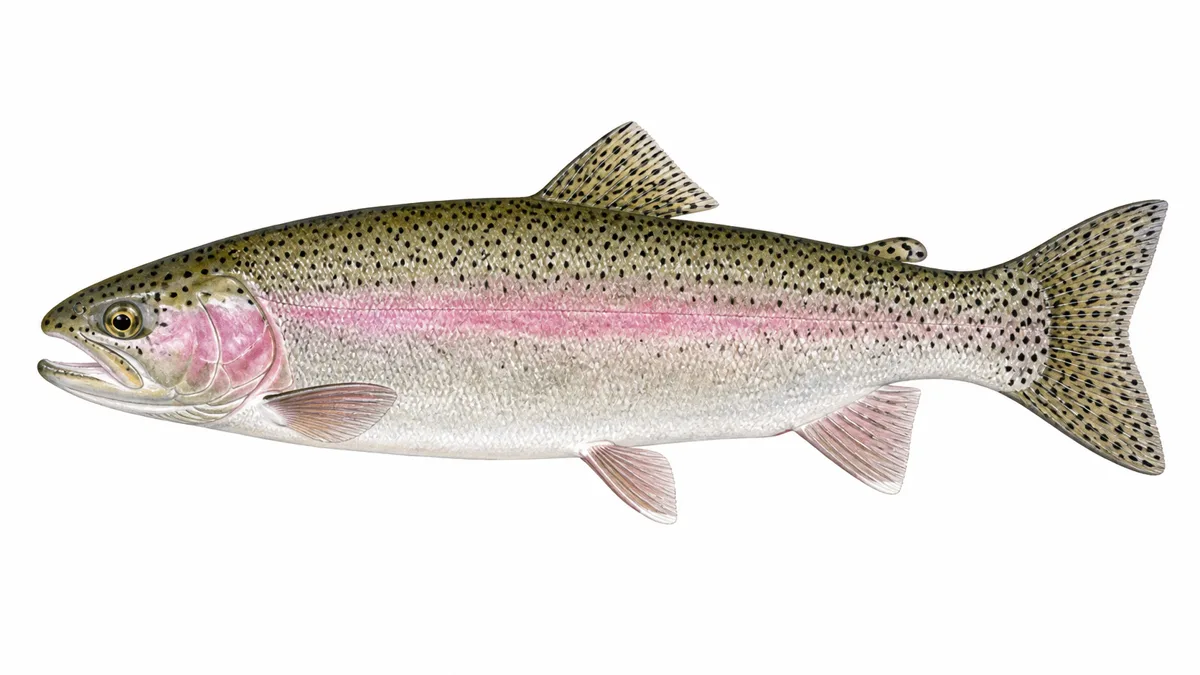
The clearest giveaway is the tail: rainbow trout carry dark spots right across the caudal fin, while brown trout typically don't. Rainbows also show a pink to red band along their flanks, whereas brown trout have more variable colouring with larger, often reddish-ringed spots along the body. Rainbows also tolerate warmer water than browns, so they're more often found in the faster, sunnier reaches of a fishery.
Is rainbow trout good to eat?
Yes, rainbow trout is widely regarded as excellent table fish, with a mild, slightly nutty flavour and flaky flesh that's less 'fishy' than many species. Flesh colour varies from white to pink depending on the fish's diet, but this doesn't affect taste. It's a popular catch to keep across both Australian and New Zealand trout fisheries, subject to local bag and possession rules.
Do you need a licence to fish for rainbow trout?
Yes, a fishing licence is required in every state and in New Zealand to target rainbow trout, and the type and cost vary by region. In New Zealand this is a Fish & Game licence; in Australia it's a state recreational or inland fishing licence, with some exemptions for juniors, seniors or concession holders depending on the state. Rules on bag limits, size limits and season closures also differ by state, so check with the relevant fisheries authority before you fish.
Fishing for rainbow trout on water you don't know?
A guide who fishes it every week writes you a plan for your water and your dates.