Spanish mackerel
A fast, schooling pelagic with a mouthful of razor teeth that shears through mono and light wire alike; troll skirted lures or bait at 6-10 knots along reef edges and current lines, and always run wire trace.
64 guides in the directory fish for spanish mackerel, across 22 regions
- Also called
- Narrow-barred mackerel
Spaniard, Doggie - Water
- saltwater
offshore pelagic, around reefs,… - Typical size
- 55-125 cm
2-15 kg - Trophy size
- 2 m +
40 kg +
Where guides fish for it
Guides who fish for it
When to fish for it
How it is fished
Trolling deep divers and skirted lures over reef
Hardbody minnows and skirted lures are pulled at 6-10 knots over reef edges and pinnacles, mixing a deep diver close to the boat with shallow runners further back to cover the water column.
When: Year-round on the run, best over the run-out tide near bait schools
High-speed metal slugs
Cast a heavy metal slug as far as possible, let it sink to the bottom over a reef or bait ball, then wind flat-out to the surface before easing into a medium retrieve that skips the lure like a fleeing baitfish.
When: First light and low-light periods, especially around new moon
Poppers and stickbaits on schooling fish
Cast poppers or stickbaits into surface-feeding schools working bait, walking or popping the lure through the commotion.
When: When fish are visibly busting up bait on the surface
Rigged dead bait (gar or pilchard)
A whole garfish or pilchard is rigged on a wired gang or jig-head-and-treble combo and either trolled slowly or drifted with a berley trail, giving off scent and a lifelike swim.
When: Reef and island edges, especially when lure bite is slow
Slow-trolled live bait
A live slimy mackerel or yellowtail scad is nose-hooked on multi-strand wire with a stinger treble and slow-trolled at 1-2 knots, often with a second bait fished deeper to cover the water column.
When: Over reef structure holding bait schools
Fly fishing reef pinnacles and headlands
Baitfish-imitation flies are cast to fish marking or working bait around reef pinnacles and headlands; takes are extremely fast with a hard initial run.
When: Year-round in the tropics, on the troll for signs of bait and working fish
The outfit
What to actually pick up, per method.
| Method | Rod | Reel | Main line | Leader | Terminal |
|---|---|---|---|---|---|
| Spin | |||||
| Jigs | 8ft to 9ft, 50-85 g, medium-heavy, casting-length with silicone guides | 6000-size threadline, 6.2:1 or faster | 50 lb braid | 2 m of 60 lb monofilament shock leader | 30 cm of 69 lb single-strand wire trace to swivel and brass ring, metal slugs 50-85 g |
| Surface lures | 7ft to 8ft, 40-80 g, medium-heavy | 5000-6000 size spin | 30-50 lb braid | 60-80 lb Tough Trace fluorocarbon | poppers and stickbaits fitted with No. 2 assist/treble hooks |
| Live bait | 7ft, not cast - trolled/drifted, 15kg class, medium-heavy | 4000-6000 size spin | 30-50 lb braid | 40-60 lb Tough Trace fluorocarbon | 49-strand multi-strand wire, nose hook plus VMC size 2 stinger treble |
| Overhead | |||||
| Trolling | 7ft to 8ft, not cast - trolled, rated to 24kg drag class, medium-heavy | lever-drag overhead, 20-30 size, high gear ratio | 15-24kg (30-50 lb) monofilament | 60-80 lb fluorocarbon or trace | trolling skirts and deep-diving hardbodies, wire trace 20-60 lb for rigged options |
| Bait | 6ft to 6ft 6in, not cast - trolled/drifted, 10-15kg class, medium | overhead, TLD15-equivalent | 10-15 kg (20-30 lb) monofilament | 44 lb single-strand piano wire trace | Mustad 7766 3/0 hooks with 22 g net lead crimped to the shank, gang-rigged for gar |
| Fly | |||||
| Fly | 9-12 weight, n/a - fly weight rod class, fast, saltwater | large-arbour, holding 200 m+ of 50 lb backing | weight-forward intermediate (or sinking when fishing deep or berleying) | 1.5 m of 60 lb fluorocarbon to 1 m of 50 lb section, fluorocarbon or wire bite tippet | Clouser Minnows and Deceivers in baitfish colours, size 1/0-3/0; poppers, Gurglers and Crease Flies for surface fish |
When they feed, and where
What makes a spot worth stopping at
Features you can pick off the water, and what the fish is doing there.
rocky headlands and points with deep water close in
current wraps around the point and concentrates baitfish against the rock face, drawing mackerel in to ambush
cast or troll along the current seam running off the point, working lures with the flow rather than against it
inshore reef edges, bombies and wrecks
structure holds bait schools like fusiliers and slimy mackerel that Spanish mackerel patrol and raid
anchor or drift up-current of the structure and either live-bait under a balloon or troll/cast lures along the edge
current lines and colour changes offshore
these seams concentrate drifting baitfish and are a magnet for cruising Spanish mackerel following bait movement
troll skirted or diving minnows along the current line, working both the clean and dirty side of the seam
continental shelf drop-offs (roughly 30-50 m)
the depth change pushes bait up and holds larger, migratory Spanish mackerel moving along the shelf
troll a spread of diving minnows and spoons at varying depths along the drop-off to locate the active depth
jetties, piers and breakwalls that hold baitfish
lighting and structure at these sites attract baitfish aggregations, especially overnight and at first light
cast heavy metal lures or spin livebait out into the current and let it swim naturally away from the structure
What it eats, and what to tie on
Diet
Spanish mackerel are aggressive, visual predators that hunt baitfish schools cooperatively, herding them into tight balls and slashing through with speed and sharp teeth; they feed through the whole water column but concentrate wherever bait is being funnelled by current or structure. They are bait-dependent, so finding fusiliers, garfish, slimy mackerel, yellowtail scad or bonito holding on a reef or current line usually means Spanish mackerel are patrolling nearby.
Prey: slimy mackerel, yellowtail scad, garfish, mullet, fusiliers, small tuna and bonito, squid
Bait
- live slimy mackerel, yakka, gar or small tuna/bonito — pinned through the nose on a J-hook with a stinger treble/single set into the flank, presented under a balloon in current or towed slow
- dead-bait strip: garfish, pike, saury, tailor or bonito — soften garfish before rigging and use two or three trolling weights on larger strip baits to stop them rolling
Lures and flies, by type
Length and weight are the point — match them to the cast weight in the outfit table.
| Type | Length | Weight | Depth | Colour | How it is worked |
|---|---|---|---|---|---|
| Surface | |||||
| popper | 135-195 mm | — | — | bait-pattern or high-contrast for visibility | fish explosively on top when mackerel are actively herding bait to the surface |
| slow-sinking stickbait | 160-200 mm | — | — | natural baitfish tones | worked with a fast, erratic walk-the-dog action to trigger explosive surface strikes |
| Hard bodies | |||||
| trolled deep-diving minnow | 140-210 mm | — | 4-8 m depending on model and troll speed | clown or hot pink in murky water, natural bait patterns in clean water | trolled at 5-8 knots on wire trace; run several models/colours at once to find the depth fish are holding at |
| shallow-diving swimming lure | 125-150 mm | — | 1-2 m | glass ghost or blue mack (bait pattern) | cast around reef edges and headlands rather than trolled deep |
| Metals | |||||
| trolling/casting spoon | — | 50-85 g | — | chrome/silver | cast from jetties or trolled behind the boat; heavier models suit deeper or windier casting |
| Flies | |||||
| Clouser Minnow (white over chartreuse) | hook size 2 to 1/0 | intermediate to fast-sinking line | — | — | all-round pattern; add liberal flash in turbid water and strip fast and erratically to trigger a strike |
| Deceiver / Epoxy or Mylar Minnow baitfish streamer | hook size 2 to 1/0 | intermediate to fast-sinking line | — | — | run on 15-20 cm of light single-strand wire bite tippet to survive the teeth without spooking fish |
| Gurgler / popper | hook size 2 to 1/0 | floating line | — | — | for surface-feeding fish; fast, erratic strips outperform a slow retrieve |
Rules and limits
| Zone | Legal length | Bag / possession | Closed season | Source |
|---|---|---|---|---|
| New South Wales — saltwater | 75 cm | 5 in total / 5 | none listed | NSW DPIRD Fisheries (Department of Primary Industries and Regional Development) · read 2026-08-21 Listed within a grouped 'Mackerel' entry — the bag limit of 5 is a combined total for the grouped mackerel species (Spotted Mackerel in the same group carries a 60 cm minimum). The asterisk on the table denotes 'Bag limit comprised of any single species or a combination of listed grouped species'. Mackerel are not on DPIRD's twice-the-bag possession list, so possession equals the bag limit. |
| Northern Territory | Not confirmed for this zone — check NT Fisheries (Northern Territory Department of Agriculture and Fisheries) → | absence is not “no limit” | ||
| Queensland — tidal — Queensland east coast | Min: 75cm | n/a — Queensland sets possession limits, not daily bag limits / 1 per person, or 4 per boat (with 4 or more people on board) | Southern Spanish mackerel waters: from 1 February to 21 February and from 1 March to 21 March. Northern Spanish mackerel waters: from 8 October 2026 to 29 October 2026 and from 6 November 2026 to 27 November 2026 (2027: 26 October to 16 November and 25 November to 16 December). | Queensland Department of Primary Industries (Fisheries) / Queensland Government · read 2026-08-21 Authority page notes 'Closed seasons apply'. The east coast is split into northern and southern Spanish mackerel waters with different closures; northern closure dates are fixed year by year in the Fisheries Declaration 2019 s 27A out to 2029, southern dates recur annually under s 27B. |
| Queensland — tidal — Gulf of Carpentaria | Min: 75cm | n/a — Queensland sets possession limits, not daily bag limits / 3 per person, or 6 per boat (with 2 or more people on board) | not confirmed — no closure noted against this row on the authority's tidal limits table, and the Fisheries Declaration closures ss 27A/27B are framed around northern and southern Spanish mackerel waters | Queensland Department of Primary Industries (Fisheries) / Queensland Government · read 2026-08-21 The authority lists Gulf of Carpentaria Spanish mackerel as a separate row from the Queensland east coast row, with a higher possession limit and no 'closed seasons apply' note. |
| Western Australia — marine | 900 mm | 3 (mixed large pelagic finfish daily bag limit; no separate individual species limit printed) / General finfish possession limit applies, including the additional 10 kg of large pelagic fillets with skin on | — | DPIRD Fisheries (WA Department of Primary Industries and Regional Development) · read 2026-08-21 Listed as 'Mackerel, Spanish' in the large pelagic finfish table. The 3-fish limit is shared across all large pelagic species. |
Blowering Dam and Copeton Dam: Exempt from the annual Murray Cod closure — Murray Cod may be taken all year in these two dams, while all other waters are closed 1 September to 30 November. · Trout spawning streams — Thredbo River and Eucumbene River (and tributaries): From 1 May to the end of the King's Birthday long weekend these waters run under separate spawning-stream rules: 50 cm minimum size, daily bag limit 1, possession limit 2, artificial fly or lure only (no handlines, no dough-based baits). · Artificial fly and lure only waters (incl. blue ribbon streams, catch-and-release streams, trophy trout dams, trout spawning streams): Notified trout waters split into two classes; in artificial fly and lure only waters the trout daily bag limit is 2 and possession limit 4 (instead of 5 and 10), and bait is prohibited. The Eucumbene and Thredbo Rivers sit in this class from the Saturday of the October long weekend to 30 April inclusive.
In the kitchen
Barbecued
regarded as one of the best barbecue fish around, firm flesh holds together
Smoked
high oiliness suits smoking, pair with a crisp dry white
Pan-fried
salt lightly first, watch it closely, it overcooks fast
Curried
firm oily flesh stands up well to strong curry spicing
Watch


Common questions
What is the best time of year to catch Spanish mackerel?
Spanish mackerel fish best from late spring through autumn, with numbers building from early December as warm currents push south along the east and west coasts. Winter still produces consistent fishing in the tropical north of Queensland, WA and the NT, where the species can be caught year-round. Early morning, particularly the first few hours after dawn, is the most productive window wherever you fish.
How big do Spanish mackerel get?
Most Spanish mackerel caught by anglers weigh 2–15kg and measure 55–125cm, though the species can grow past 40kg and over 2m in length. A fish over 15kg is a genuinely large specimen. Bigger, older fish are also the ones most likely to carry ciguatera toxin, so size matters for the table as well as the fight.
How do you tell a Spanish mackerel apart from a spotted mackerel?
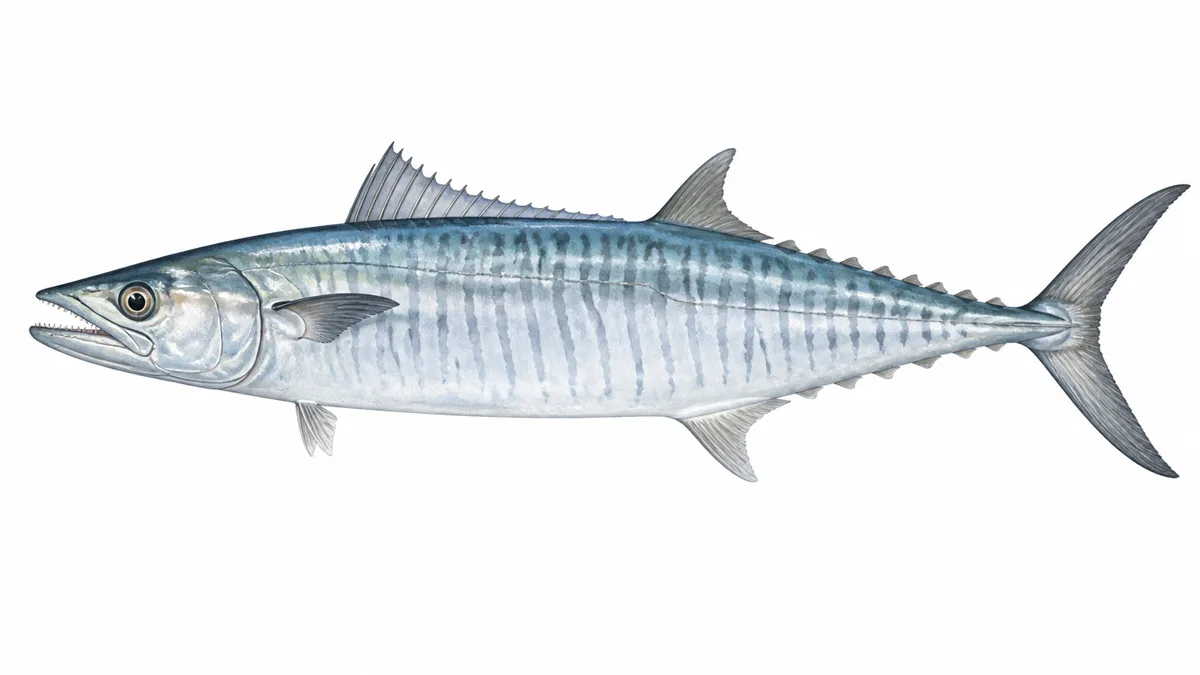
Spanish mackerel show wavy, broken vertical bars running down the flanks and below the lateral line, while spotted mackerel carry rows of distinct round spots instead of bars and lack a fully scaled anterior lateral line patch. Spanish mackerel also grow considerably larger, commonly well over a metre, whereas spotted mackerel rarely reach much beyond 60–80cm. Colour is similar on both (blue-grey back fading to silver), so the bar-versus-spot pattern is the most reliable field check.
Is Spanish mackerel safe to eat?
Smaller fish are good, safe table fare, but larger Spanish mackerel carry a real ciguatera poisoning risk, particularly from tropical Queensland reef country. As a rule of thumb, fish under about 10kg are considered lower risk, and the toxin concentrates in the head, roe, liver and other viscera, which should always be discarded rather than eaten. Cooking or freezing does not destroy the toxin, so size and which parts you eat are the only real controls.
Do you need a licence to fish for Spanish mackerel?
Licence requirements depend on the state or territory you're fishing in, so check the relevant fisheries department before heading out. Bag and possession limits, minimum sizes and seasonal closures also apply and differ by jurisdiction, so confirm current rules locally rather than relying on a neighbouring state's regulations.
What tackle do you need to catch Spanish mackerel?
Spanish mackerel are fast, hard-fighting pelagics best targeted by trolling or spinning skirted lures, minnow-style hard-bodies or metal slugs around bait schools, reefs and current lines. Wire or heavy fluorocarbon leader is essential, since their sharp teeth will bite through straight mono. Live-baiting with gar, herring or small tuna is also a proven method, especially around dawn.
Fishing for spanish mackerel on water you don't know?
A guide who fishes it every week writes you a plan for your water and your dates.