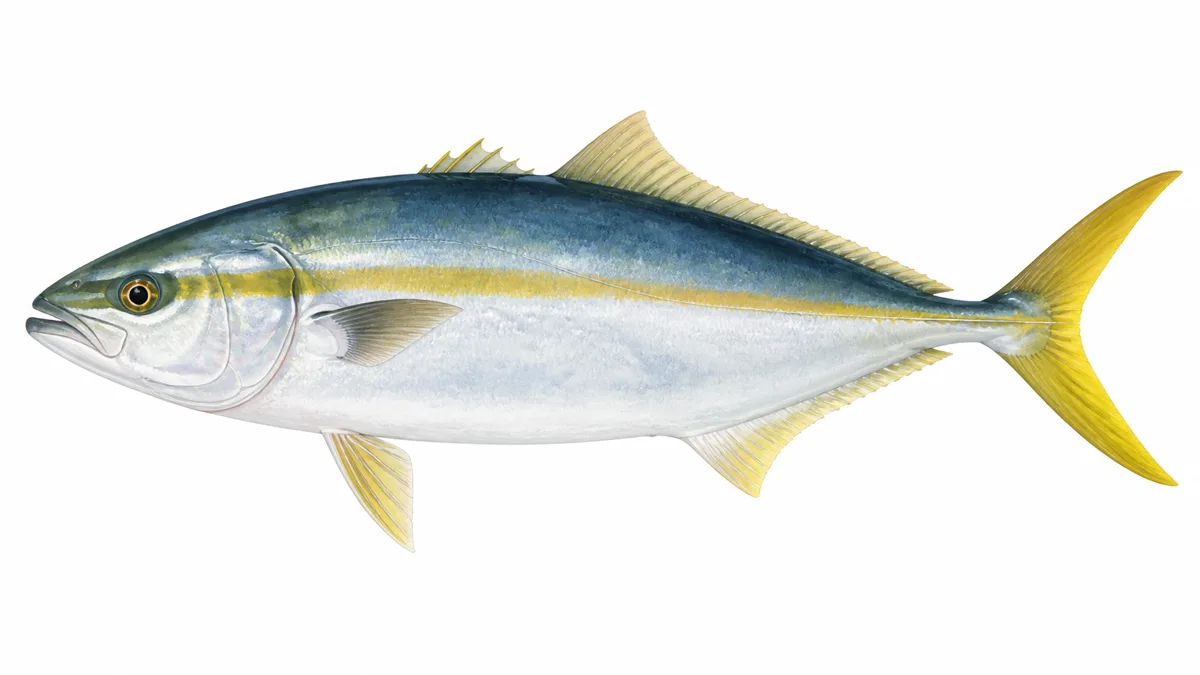
Yellowtail kingfish
A fast, hard-fighting member of the trevally family that hunts around reefs, pinnacles and drop-offs in strong current. Kingfish gather where bait is pushed against structure, so anglers target the tide change over deep reef edges and offshore islands rather than open water.
162 guides in the directory fish for yellowtail kingfish, across 34 regions
- Also called
- kingie
kingy, haku - Water
- salt
coastal reefs, pinnacles, rocky… - Typical size
- 60-100 cm
3-20 kg - Trophy size
- 1.5 m +
40 kg +
Where guides fish for it
Guides who fish for it
When to fish for it
How it is fished
Stickbaits and poppers over structure
Cast stickbaits and poppers at reefs, pinnacles, bait schools and current lines, working them with sharp sweeps and pauses to trigger explosive surface strikes as kingfish push baitfish up.
When: daylight, especially dawn and dusk when bait is active on top
Vertical knife-jigging over structure
Drop slim knife or flutter jigs to the bottom over reefs and foul ground, then work them back with fast vertical sweeps and a quick retrieve to imitate a fleeing baitfish.
When: any time of day, most effective when fish are marked holding deep on sounder
Livebaiting under a balloon or slow-trolled
Rig a livebait such as jack mackerel, koheru, kahawai or squid on a bridle or nose hook and present it under a balloon, down a berley trail, or slow-trolled around shallow reef structure where kingfish are holding.
When: all day, particularly effective on the turn of the tide
Soft plastics fished on jig heads
Cast or drop large soft plastics rigged on heavy jig heads around structure and current edges, working them with a lift-and-drop retrieve similar to metal jigging.
When: any time, useful when fish are finicky on lures or livebait
Sight-casting to marker kingfish on fly
Sight-cast large baitfish and crustacean patterns to kingfish holding on channel markers, pylons or flats, using an intermediate line to keep fly and leader tracking straight, then strip fast to trigger a strike.
When: daylight in clear water when fish can be sighted
The outfit
What to actually pick up, per method.
| Method | Rod | Reel | Main line | Leader | Terminal |
|---|---|---|---|---|---|
| Spin | |||||
| surface lure | 7ft 6in to 8ft 6in, PE3-6 (approx 40-100 g), fast, popping/stickbait action | 6000-14000 size holding 300 m+ braid, 5.7:1 to 6.2:1 | PE3-6 braid (approx 30-60 lb) | 50-100 lb mono or fluorocarbon, 1.5-2 m | BKK-style barbless trebles or single assist hooks, heavy split rings |
| metal jig | 6ft to 6ft 6in jigging rod, PE3-8 (matched to 100-500 g jigs), fast taper, high lift | 6000-8000 size spin (or lever-drag overhead for deep water), 12-13 kg drag | PE3-8 braid (approx 30-80 lb) | 80 lb fluorocarbon, 1-2 m | short squid-skirted assist hooks top and bottom, PR knot to leader |
| soft plastic | 6ft 6in to 7ft, PE3-4 spin rod, 80-400 g jig heads (depth in m x 2 = grams), medium-heavy | 6000-8000 size spin | PE2-3 braid (approx 20-30 lb) | 30-40 lb fluorocarbon (up to 80 lb around heavy structure) | 7/0-10/0 heavy-gauge jig heads matched to plastic size |
| Overhead | |||||
| live bait | PE8 jig rod (approx 5ft 8in-6ft), PE8, 6-8 oz sinker capable, medium-heavy, live-bait/jig style | lever-drag overhead, e.g. Torium-class, 12-13 kg drag | 80 lb multi-coloured braid | 100 lb fluorocarbon trace, 2-3 m | non-offset recurve hook, bridle rig or nose hook, 6-8 oz egg sinker, ball-bearing swivel |
| Fly | |||||
| Fly | 9ft, 8 to 12 weight fly rod, 8-12 weight line, fast, heavy-lift saltwater blank | large-arbor saltwater fly reel with sealed drag | intermediate or floating 8-12 weight fly line | straight fluorocarbon, 20-60 lb, 9 ft (short 8-10 kg tippet near structure) | Clouser minnows, deceivers, small poppers and crustacean patterns, size #2-2/0 |
When they feed, and where
What makes a spot worth stopping at
Features you can pick off the water, and what the fish is doing there.
reef pinnacles and foul ground in strong current
current pushing over structure lifts nutrients and concentrates baitfish, and kingfish sit on the up-current edge to ambush stragglers
anchor or drift up-current of the pin and work jigs or livebaits down onto it, or cast stickbaits across the structure and work them back through the strike zone
harbour entrances, bars and straits with heavy tidal flow
chokepoints funnel bait past a fixed ambush point, and kingfish hold in the current to intercept it
fish the peak of the run, drifting livebaits or working jigs through the deepest, fastest part of the flow
rocky headlands and bluewater bommies
current wraps around the point and stacks bait against the rock face, giving kings a natural corner to pin prey
cast stickbaits or poppers hard against the rock and work them out into open water past the wash
surface workups and baitfish schools
kingfish shadow the edges of a bust-up rather than sitting in the thick of it, picking off fish that peel away from the school
approach quietly, cast beyond the school to its margins and retrieve a lure or livebait back through the edge rather than the centre
man-made structure: wharves, marker buoys, mussel/salmon farm lines
these act as artificial reefs, holding resident baitfish and giving kings a fixed ambush point close to structure
drift or anchor up-current and work livebaits or jigs tight to the pilings/lines, ready to stop a fish before it reaches the structure
What it eats, and what to tie on
Diet
Kingfish are fast, sight-hunting predators that run down schooling baitfish and squid in short, explosive bursts of speed rather than picking at bottom scraps. They favour the fittest, fastest bait in a school and will also take crustaceans such as prawns and crabs opportunistically.
Prey: kahawai, piper, trevally, garfish, jack mackerel, slimy mackerel, koheru, yellow-eye mullet, squid, prawns
Bait
- live kahawai — best fished under a balloon on the surface in shallow water
- live piper — a standout bottom-fishing bait, rigged through the nose to extend swimming life
- live jack mackerel / slimy mackerel / koheru — versatile across depths, fished on a running rig with a ball sinker and 1.2-1.5 m heavy trace
- live yellow-eye mullet — solid all-round livebait, especially inshore and around structure
Lures and flies, by type
Length and weight are the point — match them to the cast weight in the outfit table.
| Type | Length | Weight | Depth | Colour | How it is worked |
|---|---|---|---|---|---|
| Surface | |||||
| popper | 100-200 mm | 30-100 g | — | chrome/white or bait-pattern for a natural profile | worked with sharp, splashy pops to imitate a fleeing baitfish; effective over reefs and around bust-ups |
| stickbait | 100-200 mm | 30-100 g | — | chrome/silver or dark bait colours in low light | walked across the surface with a fast, erratic retrieve; a standout for kings holding on rock edges and current lines |
| Soft plastics | |||||
| paddle-tail on jig head | 120-180 mm | jig head a few grams up to 25 g in shallow water | 0.5-3 m | bait-pattern or bright pink/white | a lighter-tackle option for smaller kings and shallower structure |
| Vibes and blades | |||||
| soft vibe | 90-100 mm | 20-30 g | 1-10 m depending on retrieve and sink time | red head or natural baitfish tones | cast and worked with a lift-drop retrieve through the water column, useful for fish sitting off structure rather than on top of it |
| Jigs | |||||
| knife/slow-pitch or high-speed metal jig | — | 150-300 g | worked from bottom up through deep reef and pinnacle water | green-yellow, pink-white or blue-white/silver, chrome in clear water | matched to depth and current — heavier jigs for deeper, faster-flowing marks; smaller kings can be taken on lighter 80-150 g jigs |
| Flies | |||||
| Clouser minnow / baitfish deceiver (piper imitation) | 4-6 in | floating, intermediate or sink-tip line on an 8-10 weight rod | — | — | piper make up a large part of the diet, so slim baitfish profiles fished on intermediate line with a short 8-10 kg tippet work well |
| popper fly | 4-6 in | floating line | — | — | splashy surface retrieve imitating a panicking baitfish, effective around bust-ups and reef edges |
| heavily-dressed weighted clouser with rubber/silicone legs | 3-5 in | intermediate/sink-tip line | — | — | a crustacean pattern in drab greens/browns for kings feeding on prawns and crabs |
Rules and limits
| Zone | Legal length | Bag / possession | Closed season | Source |
|---|---|---|---|---|
| New South Wales — saltwater | 65 cm | 5 / 5 | none listed | NSW DPIRD Fisheries (Department of Primary Industries and Regional Development) · read 2026-08-21 Listed on the table as 'Yellowtail Kingfish'. Not on DPIRD's twice-the-bag possession list, so possession equals the daily bag limit. |
| New Zealand — marine | Not confirmed for this zone — check Fisheries New Zealand (Ministry for Primary Industries) → | absence is not “no limit” | ||
| New Zealand — sports fish | Not confirmed for this zone — check Fish & Game New Zealand → | absence is not “no limit” | ||
| New Zealand — Taupō District | Not confirmed for this zone — check Department of Conservation (Taupō Fishing District) → | absence is not “no limit” | ||
| Queensland — tidal | Min: 60cm | n/a — Queensland sets possession limits, not daily bag limits / Limit: 2 | Queensland Department of Primary Industries (Fisheries) / Queensland Government · read 2026-08-21 Listed in the trevally group of the tidal table with its own limit, separate from amberjack and samsonfish which share a combined limit of 2. | |
| South Australia — marine | 60 cm minimum | 1 / not confirmed | none listed | PIRSA (Primary Industries and Regions South Australia) — Fisheries and Aquaculture · read 2026-08-21 Length measured from tip of snout to tip of tail. Daily boat limit 3 where 3 or more people are fishing on board. |
| Tasmania — inland | Not confirmed for this zone — check Inland Fisheries Service (Tasmania) → | absence is not “no limit” | ||
| Tasmania — marine — marine | 45 cm minimum | 5 / 10 | none — Tasmanian recreational scalefish seasons apply only to striped trumpeter, banded morwong, southern garfish, squid and calamari (plus rock lobster and scallops) | NRE Tas (Department of Natural Resources and Environment Tasmania) — Wild Fisheries Management Branch, Recreational Fisheries Section · read 2026-08-21 Listed as "Kingfish, Yellowtail". Measured "from the nose to the end of the tail". No boat limit listed. Rules current for the guide period 1 November 2025 – 31 October 2026. |
| Victoria — marine and estuarine | 60 cm minimum legal size | 2 / not specified by the authority (daily bag limit applies) | none stated | Victorian Fisheries Authority (VFA) · read 2026-08-21 Listed by VFA as Seriola lalandi. Recent change: the 2026 Recreational Fishing Guide 'Reduced bag limit for yellowtail kingfish from 5 to 2'. |
| Western Australia — marine | 600 mm | 3 (mixed large pelagic finfish daily bag limit; no separate individual species limit printed) / General finfish possession limit applies, including the additional 10 kg of large pelagic fillets with skin on | — | DPIRD Fisheries (WA Department of Primary Industries and Regional Development) · read 2026-08-21 Large pelagic finfish category, same 600 mm minimum as samsonfish and amberjack. |
Blowering Dam and Copeton Dam: Exempt from the annual Murray Cod closure — Murray Cod may be taken all year in these two dams, while all other waters are closed 1 September to 30 November. · Trout spawning streams — Thredbo River and Eucumbene River (and tributaries): From 1 May to the end of the King's Birthday long weekend these waters run under separate spawning-stream rules: 50 cm minimum size, daily bag limit 1, possession limit 2, artificial fly or lure only (no handlines, no dough-based baits). · Artificial fly and lure only waters (incl. blue ribbon streams, catch-and-release streams, trophy trout dams, trout spawning streams): Notified trout waters split into two classes; in artificial fly and lure only waters the trout daily bag limit is 2 and possession limit 4 (instead of 5 and 10), and bait is prohibited. The Eucumbene and Thredbo Rivers sit in this class from the Saturday of the October long weekend to 30 April inclusive.
In the kitchen
Raw
Prized for sashimi and poke when bled and iced well
Barbecued
Sear hot, take off medium-rare so it stays moist
Smoked
Its medium oil content suits smoking well
Pan-fried
Skin crisps up nicely, few bones to work around
Watch


Common questions
What is the best time of year to catch yellowtail kingfish?
Kingfish fishing peaks over the warmer months, roughly January to April in most of Australia and from late November through to April in New Zealand, as fish follow water above about 20°C onto reefs and structure. They can be caught year-round in northern NSW and Queensland, but numbers and size both improve through summer into autumn. Look for a running tide over deep reef or structure during this window.
How big do yellowtail kingfish get?
Most fish caught by anglers run up to about a metre long and 10–15kg, though the species can grow much larger. The IGFA all-tackle world record stands at 52kg, jointly held by two New Zealand anglers, while the Australian all-tackle record is a 36.74kg fish taken in Queensland. Exceptional individuals can reach close to 2 metres and around 70kg.
Is yellowtail kingfish good to eat?
Yes, kingfish is a premium-eating, firm white-fleshed fish that's especially prized raw as sashimi. A minority of fish carry a microscopic parasite that can turn the cooked flesh soft or 'mushy', though most infected fish from NSW waters cook up fine, and there's currently no evidence the parasite causes illness in people who eat it. If a fillet looks unusually soft or milky, it's safest not to eat it.
Do I need a licence to fish for kingfish?
In New Zealand, no licence is needed for saltwater fishing by anyone, resident or visitor, though bag and size limits still apply. In Australia, most states require a recreational fishing licence for anglers over 18 fishing in saltwater, including NSW and Queensland. Limits apply and differ by state, so check the relevant state fisheries department before you fish.
How do you tell a kingfish apart from a samson fish?
The most reliable check is the dorsal fin ray count: yellowtail kingfish have 31–34 rays compared with a samson fish's 23–25. Visually, kingfish are slimmer and torpedo-shaped with a bright yellow tail and a brassy stripe along the flank, while samson fish are heavier through the head and shoulders with a duller, greyish tail and a squared rear edge to the upper jaw. The two species belong to the same genus and sometimes school together, which is why they're often mixed up.
Fishing for yellowtail kingfish on water you don't know?
A guide who fishes it every week writes you a plan for your water and your dates.