Find the gutter first
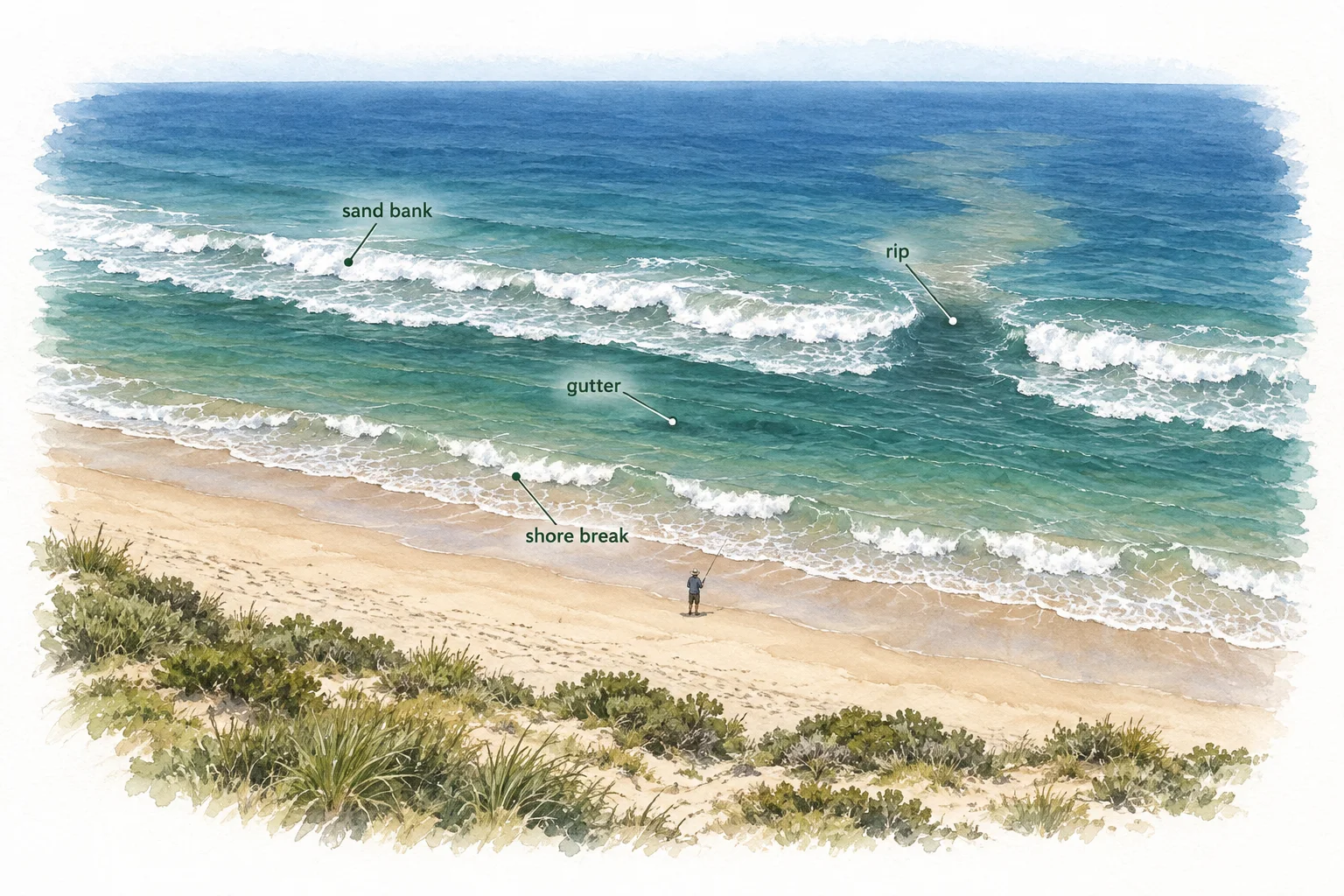
Look for a band of darker green water where waves rise but don't break, backed by a sandbank spilling whitewater that traps bait. In front of the gutter the sand often cuts away steeply into deeper water. Check each end for an entry and exit point, and note any coffee rock nearby, since it holds fish through the day.
Tall dunes behind a gutter shade the water and can bring the bite on earlier than a stretch fully in the sun. Further out, birds working over the surface mark a school of tailor moving along the beach.
If a gutter gives nothing after a few casts, or about five minutes, move to another one. Gutters shift with the sand and a spot that fished well can be dead within a day or two, so treat every session as a fresh read of the beach.
What a tailor gutter looks like from the dune
The outfit
Rod
4.1–5 m, 7–10 kg; 10–15 kg for very large fish
Casts whole pilchards past the break and has power to turn big tailor.
Reel
6–6.5 inch sidecast spool
Matches the long surf rod for distance casts with light bait.
Main line
20 lb mono, thin diameter
Thin diameter adds casting distance off a sidecast spool.
Trace
30–40 lb fluoro; 25–30 cm and 60–70 cm traces (50 lb at night)
Fluorocarbon resists abrasion from sand and the fish's teeth.
Sinker
Ball sinker size 5–9 (4–10); soft bead, glow bead at night
Sized to the swell so the bait holds bottom without dragging.
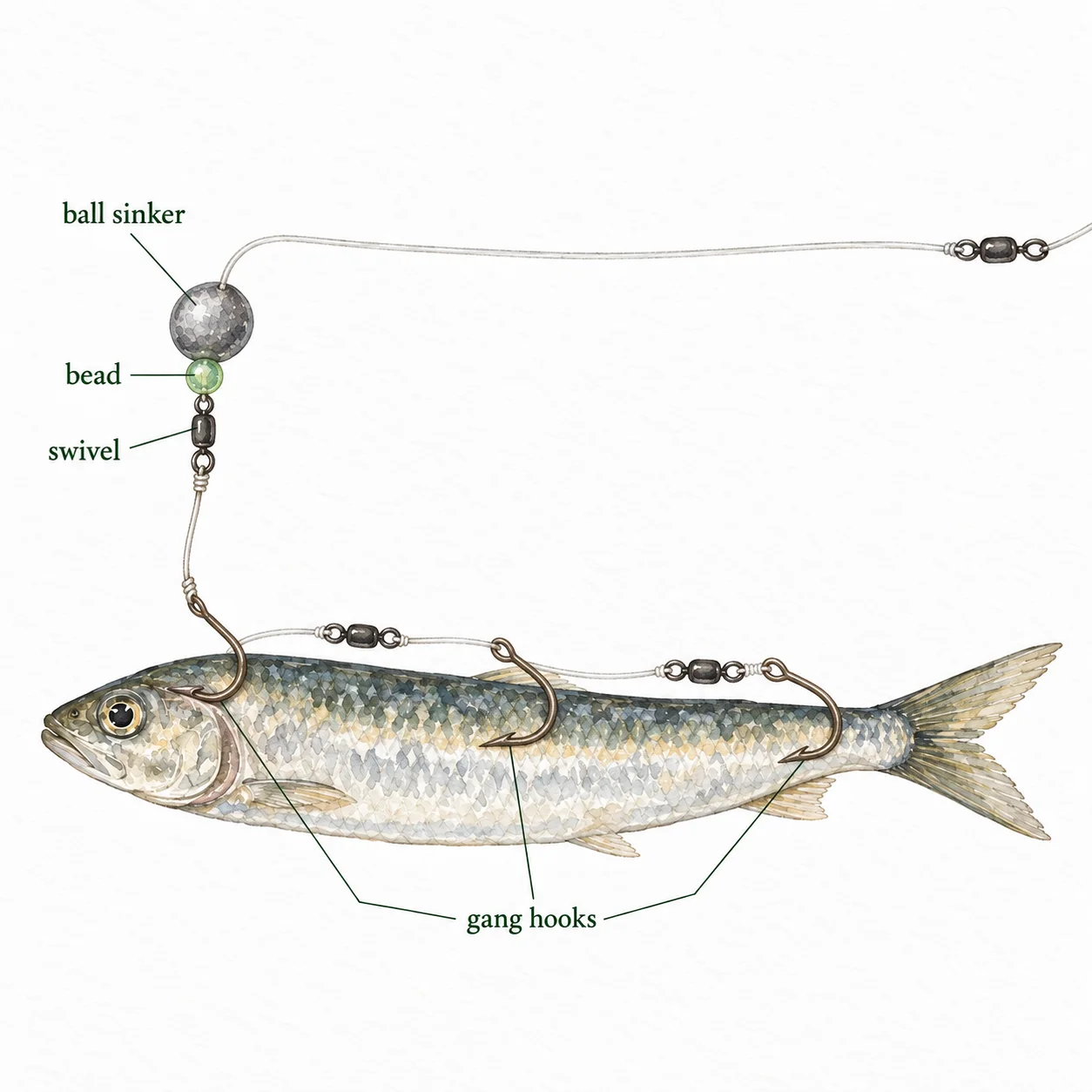
Gang hooks
3 × 4/0, up to 6/0 for big fish
A gang links 2 to 4 hooks eye-to-gape so the points sit near the bait's tail.
Bite guard
150 mm of wire, or a short heavy leader
Stops tailor's sharp teeth biting through the trace.
Bait
Whole individually frozen pilchards, not block-frozen
Firmer for casting than block-frozen; garfish, bonito, whitebait, bluebait or mullet strip work too.
Lure outfit
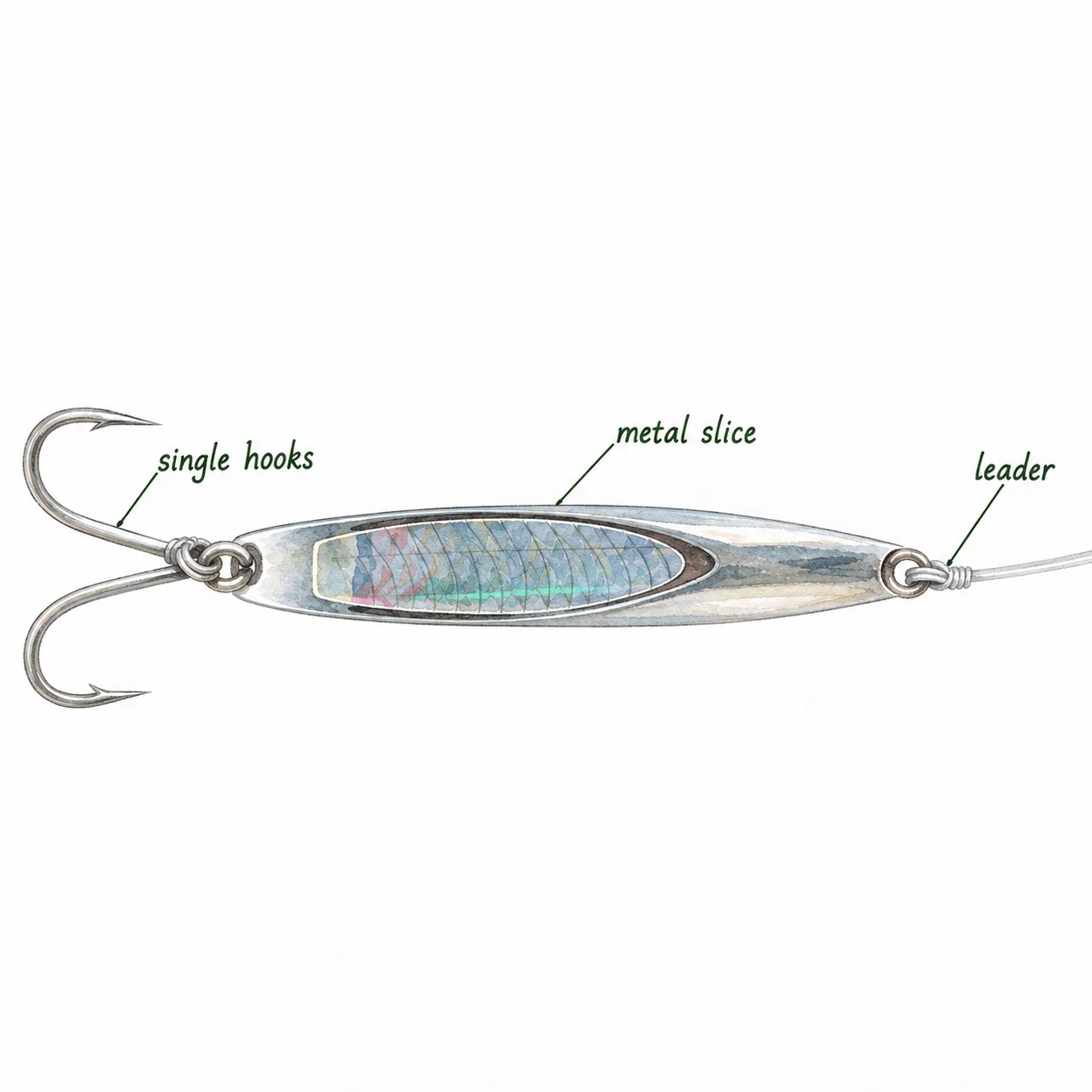
3.4–4 m rod, 5–8 kg, 4000–5000 reel, 20 lb leader, 15 lb braid
Swap to this outfit for spinning metal lures instead of bait.
The bait rig
The lure rig
Do it
Match the gang to the bait
Choose a gang size and hook count so the last hook point sits near the tail of the pilchard. A longer bait takes more hooks in the gang.
Rig the pilchard straight
Push the top hook through the head just behind the eyes, then pin the rest along the body so every point shows and the bait lies straight. Break the backbone joints for flex.
Cast to the back bank
Cast the ganged pilchard toward the back bank of the gutter. Wind up any slack at once, as tailor can take the bait the moment it lands.
Retrieve slowly and low
Wind back slowly with the rod tip about a metre above the surface and off to the side. Shorten later casts once fish start hitting close in.
Tip Some anglers leave the bait still, adding sinker weight to hold it against the current, and only retrieve if that fails. Sources disagree on which works better.
Wait for the rod to load
Keep winding through the bites and strike only when the rod loads with the fish's full weight. Then hold the rod at 60 to 90 degrees to the water.
Berley a distant school
When birds show tailor working further out, cut up pilchards and berley to draw the school in toward the gutter.
When to fish
Tide and wind advice below comes from sources that partly disagree; treat both options as worth trying.
| Condition | Best call | Basis |
|---|---|---|
| Light | Dawn and dusk | Feeds hardest in low light; WA also bites on the summer afternoon sea breeze |
| Tide | High, late afternoon | Fish the gutters and deep water; tide advice differs between sources |
| Tide | Falling, a few hours after the turn | Preferred at dawn or dusk by other sources |
| Tide | Avoid mid-tide | Strong sweep makes the retrieve difficult |
| Moon | Full and new moon | Most productive sessions are reported around these phases |
| Wind | Westerly | Flattens the sea and brings bait in; sources differ on why it works |
| Wind | Strong south-easterly or north-easterly | Raises the swell and blows the beach out |
| Season | August and September (Qld beaches) | Peak months on Queensland's open surf beaches |
| Season | October to December (Qld beaches) | Bigger fish arrive, in smaller numbers |
| Season | September (K'gari) / February to April (NSW north coast) | Spawning peaks at these places and times |
Pilchard or metal lure
Pitfalls
Casting at random into a school, or behind a moving one, scatters it.
Instead Plan each cast and lead the school instead.
Striking as soon as a bite is felt pulls the hooks out.
Instead Keep winding through the bites and strike only once the rod loads with weight.
The bait sits bent on the gang, so it spins in the air and falls short.
Instead Rig the pilchard straight along the hooks before casting.
Sweep drags the bait sideways out of the gutter.
Instead Switch to a star sinker on a paternoster rig; a three-dropper version is a newer, less tested option.
Staying on a gutter that keeps producing nothing.
Instead Move to another gutter after a few casts or about five minutes.
Tailor's sharp teeth bite through light line, leaving hooks with no fish.
Instead Add a short length of heavy leader, or about 150 mm of wire.
Common questions
What size gang hooks should I use for a small versus a large pilchard?
Match the gang to the length of the pilchard so the last hook point sits near the tail. The traditional gang is three 4/0 hooks; some anglers carry sizes from 3 x 2/0 up to 5 x 7/0, moving up to 6/0 for big tailor.
Do I need wire trace for tailor, or is heavy fluorocarbon enough?
Either works. Use 30-40 lb fluorocarbon leader, or 50 lb monofilament at night, and add about 150 mm of wire on shorter rigs if bite-offs keep happening.
Can I catch beach tailor on a standard spinning reel instead of a sidecast reel?
Yes. For spinning metal lures, use an 11-13 ft rod rated 5-8 kg with a 4000-5000 reel, 15-20 lb braid and a 2.5 m fluorocarbon leader of about 20 lb; lighter combos down to a 2500 reel suit smaller 20 g metals.
How do I stop tailor biting off my pilchard without hooking up?
Tailor chop along a bait, so keep winding slowly through the bites rather than pausing. Strike only once the rod loads with the fish's weight; striking early pulls the hooks out before they've taken hold.
Is tailor good to eat and how should I keep it?
Yes, but bleed tailor straight after capture and hold it in an ice slurry. Eat it fresh, as the flesh does not freeze well.
When do tailor run on NSW and WA beaches?
On the east coast, tailor migrate north in autumn and winter to spawn at K'gari, peaking in September, with a second spawning run on the NSW north coast in February to April. The eastern stock ranges from Bundaberg through NSW to eastern Bass Strait and the western stock from Exmouth to Esperance in WA, but no source here gives WA run months.
Guides who fish this
28 listed in the directory. A guide’s local judgement is the part no page can hold.
- BK's Gold Coast Fishing ChartersGold Coast
- Caloundra Fishing WorldSunshine Coast
- Charlton's FishingBrisbane River
- ClintGold Coast River Fishing Charters (continuation of Brad Smith Fishing Charters) · Moreton Bay
- Coastal Sportfishing SafarisGold Coast
- Cody HochenMoreton Bay
Main sources
- Tailor time on beachesBush 'n Beach Fishing Magazine
- Scott's Species – tailor, tough predators with razor teethRecfishwest
- How to: Ganged hooksFishing World
- Tailor 2020 (Status of Australian Fish Stocks)FRDC / Status of Australian Fish Stocks
All 13 sources
- Tailor time: new and old tailor rigs · Bush 'n Beach Fishing Magazine
- Experimental tailor tactics · Fishing Monthly
- Big tailor surf tactics · AFN Fishing & Outdoors (Cliff Andreassen)
- Tips for Targeting Tailor · Tackle Tactics (Justin Willmer)
- Whole Fish on Ganged Hooks · Tackle Tactics
- Tailor Time - How to Catch Tailor · Tackle Tactics
- FISH FACTS: Learning more about tailor · Fishing World (Ben Diggles, 6 July 2020)
- Tailor off limits at Fraser Island · Fishing World (4 August 2014)
- Size and possession limits in tidal waters · Queensland Government
Something wrong on this page? Tell us and it gets fixed.